Monday, May 28, 2012

1982


A while back I wrote something about how people didn’t send postcards anymore.  A couple of days after I posted that bit of wisdom, I received a postcard from a good friend of “The Teacher” refuting my claim and asking me to write something about the 1982 World Series.  Apparently, the Teacher had told her friend that I had been at all three of the games played in Milwaukee.  So this one is for you Will.  Be patient, as there will be a fair amount of meandering before we actually get to Milwaukee in October of 1982.

 I was working for the Chicago and Northwestern railroad as a trackman based out of Minneapolis.  I had transferred to the Minnesota division the year before from the Wisconsin division, where I had been based out of Milwaukee.  A trackman is the grunt that performs the hard labor of building, repairing and maintaining railroad tracks and rights of way. 

1982 was the second year of the grand voodoo economics experiment that would eventually get us to the collapse of 2008 and the Great Recession we are still struggling to put behind us.  The unemployment rate was at 9.7% and as a result the railroads were not calling back their employees as they normally did in the spring.  As the summer melted away and things did not improve, my only opportunity for work was to join a rail gang that was starting up out of Huron, South Dakota.

And so it was I found myself in South Dakota.  My first impression of the eastern half of South Dakota was how isolated it seemed.  In fact, the most impressive thing about the place was its emptiness.   As I looked out across the flat landscape of endless grass, the place gave me the willies.  I was used to cities and all this open territory somehow felt a little ominous.  It is a little known fact that the Dakotas were two of the last states settled by Europeans in the continental United States.  Looking out across the plains gave me a new appreciation for the courage of the people who built sod houses and became the first white residents of South Dakota.

Nothing in Eastern South Dakota

You feel more vulnerable to the whims of weather when there is nothing between you, a vast prairie and Mother Nature.   One day I was working on the tracks at 7:00am and the sky was blue and the temperature was in the low seventies.  By 10:00am, the temperature had dropped 25 degrees and a cold rain was being whipped into our faces by a strong wind.  By 1:00pm, the temperature dropped another 20 degrees and a blizzard had begun.  When the natives said, “If you don’t like the weather wait ten minutes and it will change,” they weren’t kidding.

The isolation went beyond the physical landscape.  Huron had been created in the 1880's as a direct result of the Chicago and Northwestern Railroad’s decision to place a regional office there.  The name refers to the Huron Indians but no one knows who decided to call it that, but it is believed that someone in the Railroad’s office named the town.

Huron had a population of about 12 thousand and was the largest town in the immediate area.  There was virtually nothing for someone who didn’t live there to do and it was a challenge to find places to eat dinner.  The place we frequented the most was one of those all you can eat buffet style barns where the food may not be very good but there is a lot of it.  Cheryl Jean Stoppelmoor, a Huron native, changed her name to Cheryl Ladd, and replaced one of the original Charlie’s Angels.  She was a source of civic pride and the buffet barn was reportedly owned by this lesser or replacement angel.

Cherly Jean Stoppelmoor
Photo Credit: A European Spanish Fan Site About "Charlie's Angels"


South Dakota was right in the middle of the campaign to elect its governor.  On the Republican ticket, Bill Janklow was well known and the newspaper and TV news shows often-featured stories about him.  As the campaign progressed, I noticed that there had been no mention of Janklow’s opponent, on TV or in the local press.  I took to asking every local I ran into who was running against the Republican and no one could tell me.  On election night, I found out Janklow had won with 70.9% of the vote.  The Democrat was named O’Brien and I think it was a miracle he had managed to reach 29%.

Janklow would serve 16 years as Governor of South Dakota.  He was the Governor who pushed through legislation that abolished South Dakota’s law limiting the amount of interest a bank could charge it’s customers and successfully wooed Citibank to South Dakota.  He also abolished the state’s department of environmental protection.  His political record could probably be debated but it was in his personal life where he really distinguished himself.

In 1973 Janklow was arrested for drunken driving on an Indian reservation.  The arresting officer said in his report that Janklow insulted him, resisted arrest, tried to elude the police and wasn’t wearing any pants.  The next day an aide brought him some underwear and pants so he could leave the police station without unduly hanging out (See Author’s Notes from Naked Came The Gringo post).

In 1974 he was accused of raping his Native American baby sitter.  He denied the charges and was never indicted. Later he unsuccessfully sued author Peter Matthiessen and Newsweek magazine for libel when they published accounts of the accusation.

Janklow went on to be stopped 16 times for speeding when he was Governor.  He wasn’t ticketed for any of these violations.  An investigation revealed that he had not been given tickets “out of respect for his office and fear of retribution.”  In 2003, he killed a motorcyclist when he was speeding and ran a rural stop sign.  He was convicted of second-degree manslaughter and resigned his congressional office the next day. This finally ended his political career and began his career as a convicted felon.  He went to prison and settled a civil suit with the family of the deceased for one million dollars.

Quite a record for the man who was the dominant force in the State’s politics for over 20 years.  I guess if you are a pheasant hunter, like elbow room, and want to be left alone, that part of South Dakota is for you.  About the only thing I, personally, can recommend eastern South Dakota for is its beef jerky.  Best jerky I have ever eaten.  So, if beef jerky is high on your list of priorities, I can whole-heartedly recommend the Huron area.

Every morning around 6:30am the gang would meet at a parking area in Huron and be bused to the work site.  The man running the gang was about six foot four inches tall and two hundred and thirty pounds of muscle.  He was Native American and was the highest ranking minority person I ever ran into on the railroad.  He was also the most intimidating individual I have ever run into, period.  When he would stride down the tracks people got busy fast and made every attempt not to draw his attention.  My lasting image of him is when he stood out in a howling snowstorm with just a tee shirt on and drove the gang to work faster.  He was a warrior.  He made me think, if I had been one of those sod house settlers 130 years ago, and looked out and saw this guy in my front yard, I would have had to turn to Ma and ask her to fetch me a clean set of britches. There were a lot of stories about him, all of them centering on what happened to the sorry characters that crossed him.

In early October the Brewers completed an improbable come back from two games down in the five game American League Championship Series when Cecil Cooper drove in the tying and winning runs in the bottom of the seventh inning of the fifth and deciding game.  The Brewers, for the first time in their history, were headed to the World Series.

The day after the Brewers had punched their ticket to the World Series, the boss of the rail gang gathered us all together before we began work and told us that we were behind schedule and we were going to catch up.  From that day on, he told us, there would be no days off.  If you became ill you would need a doctor’s note detailing your near fatal illness or lose your job.  There would be no exceptions.  He had been short, direct and to the point and all of us figured come hell or high water we would work every day till the gang was disbanded.

That evening I received a phone call from my old foreman and good friend in Milwaukee, telling me that he had a ticket for me for all three of the Brewers Series home games, and asking me if I could get to Milwaukee for the games.  I thought about the boss’s speech for about a second and told my friend I would be there.  We made plans to meet at the Dairy Bar on Bluemound Road before the first game in Milwaukee.

After hanging up I immediately started to think about two problems I was facing.  First, and by far the easiest was the logistics of getting from Huron to Milwaukee. I was taking turns driving to Huron from Minneapolis with another trackman and this was the week when I didn’t have a car in South Dakota. I called up the bus station and asked about taking a Greyhound from Huron to Milwaukee.  I found out it took forever to go to anywhere from Huron.  The bus was out.  I thought about hitch hiking but that mode of transportation had fallen out of favor by then and I didn’t want to risk being out on the road somewhere when the first pitch was thrown.

I called the airport to see what a round trip ticket to Milwaukee would run me and found it was more than I could afford.  I hung up and thought about my dilemma.  I called the airport back and asked about the cost of a one-way ticket to Minneapolis and found that price was acceptable.  The plan was to fly to Minneapolis and pick up my car and drive to Milwaukee.  I would then drive directly back to South Dakota after the last game.  With that problem solved, I turned to my far stickier problem.  How was I going to get the time off and keep my job?

I lay awake that night running half a dozen schemes, out and out lies, and other strategies for talking my way to the World Series but none of them felt right.  As the night wore on, I came to the conclusion that my only course of action was to, gasp, tell the truth.  Having made that decision, I was able to fall asleep.

The next day it was weighing heavily on my mind that, at the end of the day, I was going to go to the boss’s trailer and make my pitch for missing work Thursday through Monday.  It wasn’t lost on me that he had made his speech just the day before and those stories I’d heard about him weren’t easing my mind any.

The work day finally ended and as I made my way toward the boss’s trailer I still wasn’t sure exactly what I was going to say to him.   When I entered the trailer, he was doing paper work and slowly looked up and said, “What do you want?”  I took a deep breath, and said, “A friend called me last night and he has a ticket for me for all of the World Series games in Milwaukee.  You can give me permission to go and I will be back Tuesday or you can refuse to let me go and I will go anyway and not bother to come back at all.”  He looked at me for a long moment and said, “Put your name on that calendar on Thursday and Tuesday.”  I picked up a pen off his desk and wrote my name on the calendar and left the trailer without another word.  I had learned early, when you get the answer you want, get the hell out of there before anyone has a chance to change his or her mind.

As I left the trailer, I wondered where that spiel had come from.  I hadn’t planned to put my job on the line and I don’t know if I would have quit if he had called my bluff but I think it was likely.  Happily, I didn’t have to make that call and I was headed to the World Series.

The next night the Series began in Saint Louis and I watched the Brewers destroy the Cardinals 10 to 0 with a bunch of my railroad friends.  Paul Molitor set a Series record with five hits and Robin Yount added four more.  One of the great things about the World Series is that it is a series and if you play a poor game early on there is plenty of opportunity to make up for it.
 
Game two was played the next night and the Cardinals came from behind to win.  The Cardinals catcher Darrell Porter, a former Brewer, stroked a two out, two run double that tied the game at 4 and the Brewers reliever Pete ‘Bigfoot’ Ladd ended up walking pinch hitter Steve Braun in the bottom of the 8th forcing-in the game winning run and tying the Series at one game a piece.  The next day was a travel day for the Cardinals, Brewers and me as the Series shifted to Milwaukee.

A friend dropped me off at the Huron airport terminal around noon.   I walked into the ticketing and waiting area to buy my ticket.  The room was about 16 by 20 feet and I walked up to the counter to buy my ticket for Minneapolis.  That accomplished, I looked around and saw there was another square room attached to the waiting room that promised cold beer.  I asked the desk person how I would know when my flight was ready for boarding and she told me not to worry about it.  About half way through my first beer, the same woman came and got me and told me my flight had arrived.  I followed her out of the terminal and across the tarmac where a very small jet waited.  Just out side the jet were three very fat cowboys, complete with boots, belt buckles and ten-gallon hats.  My first thought was, could this tiny plane get the four of us off the ground.  They were jovial fellows and we stood around making small talk waiting to get on the plane.  Before long the co-pilot opened the hatch and we climbed aboard. 

Soon we were airborne and then twenty minutes later we were on the ground in Mitchell, South Dakota and the cowboys got off the plane.  The co-pilot parted the curtain that separated the cockpit from the passengers and said, “It looks like just you and us for the rest of the way.”  So I settled back for my own personal flight to Minneapolis.  There seems to be something between South Dakota and me when it comes to being alone.  Years later, I would find myself in Sioux Falls on business and went to a big downtown mall to see a movie and found myself the only person in the theatre.  I felt like Elvis.

The next day I started out on the five and a half hour drive to Milwaukee.  When I got there I could feel the excitement through the car windows.  There were banners everywhere and it wasn’t long before I saw a giant foam Brewer’s logo walking down the street high fiving everyone in sight.  The place was absolutely giddy with anticipation.  It is amazing how a sporting event can unify a community.  I wish some of that magic could be applied to solving hunger or homelessness but those are complex social dilemmas and the World Series is about fun and games.  Regardless, it is a really cool feeling when a whole city gets on the same page and everyone shares a goal and point of emphasis.

The first thing I did was to head to the Dairy Bar to meet my friend with the tickets.  The bar was full and pre game festivities were in full swing.  As I walked in the door, I spotted the brother of a friend who lived in Fairbanks Alaska.  He had come from the frozen north for the Series.   All bragging rights relating to travel to the Series flew out the window.  Of all the bars in Milwaukee, he happened to be sitting in the one I walked into.  Play it again, Sam.

The Upper Deck at Milwaukee County Stadium was shaking in the 7th inning of Game 4
Photo Credit:  here    
I connected with my friend and after warming up at the bar we headed over to County Stadium.  One thing was apparent.  The Saint Louis fans and the Milwaukee fans were mirror images. Both cities were populated with a lot of German beer-drinkers and despite each sides’ loyalty to their teams, everyone got along swimmingly.  The parking lot was full of costumed characters and people without tickets set up TVs so they could watch from the parking lot and feel part of the action.

Another great thing about a World Series is that it is played in the hometowns of the participating teams.  As a result, the fat cat to average fan ratio is reversed, say, from a Super Bowl.  Both Saint Louis and Milwaukee are great baseball towns and a much larger percentage of their actual fans filled the seats for each of the games.

As we entered the stadium, the anticipation was something like a physical force.  Milwaukee was primed and ready to explode.  Then Game 3 happened.  The Brewers got behind and never gave their pent up fans anything to cheer about.  Willie McGee, who had hit four home runs all season, hit two in Game 3 and the Cardinals won 6 to 2, giving the Cards a two game to one lead in the Series.

The next night Brewer fans again were ready to tear down the stadium but as the game progressed, and the Cards took a 5 to 1 lead into the bottom of the seventh inning, anxiety had replaced the euphoria.  The fans had sat through 16 innings with little or nothing to cheer about and it was getting late.
In the bottom of the seventh, a Cardinal error and a Don Money single put two runners on with two outs. The Brewer’s second baseman Jim Gantner lit the fuse when he doubled in Ben Ogilvie to make the score 5 to 2.  The stadium erupted.  I was in the second deck above first base and the deck was actually vibrating under our feet.  Sixteen innings of frustration began to be forgotten.  Paul Molitor drew a walk to load the bases.  Robin Yount singled to right driving in two runs to make it 5 to 4.  Cecil Cooper then singled, driving in Molitor and the game was tied.  The crowd was on its feet and the roar was deafening.  I had never heard anything quite like it and would not hear anything approaching it until the noise at the 1987 World Series at the Metrodome matched and exceeded it when 25 years of Minnesota professional sports frustration was released in the enclosed confines of the Dome.  But the Brewers weren’t done.  Gorman Thomas singled in two runs after the Cardinals intentionally walked Ted Simmons and the bedlam hit another level.  The party was on.  The Cardinals went quietly in the 8th and 9th and the Series was tied two games apiece.  I wonder how much beer was consumed that night in Milwaukee? I’d like to report I held up my end.

In Game 5 the Brewers took a 6 to 2 lead into the ninth inning.  Robin Yount had a home run, double and four hits to lead the Brewers.  The Cardinals scored 2 in the top of the ninth making the final score 6 to 4.  The Brewers were headed back to Saint Louis with a three game to two lead and would need just one more win to secure their first World Series title.

I gathered my frazzled self and drove to South Dakota the next day.  The Brewers would get clobbered 13 to 1 in game 6 to even the Series. In Game 7 Milwaukee was leading 3 to 1 in the sixth inning when the Cardinals combined a double, a walk and two singles to score three runs making it 4 to 3 Saint Louis.  The Cardinals added two runs in the bottom of the 8th and went on to win their umpteenth World Series.

The Brewers wouldn’t see the post season for the next 26 years and wouldn’t win a playoff series for 29 years.  They have never won a World Series, but hope springs eternal.  For a brief time in October of 1982 the city of Milwaukee, in fact the whole state of Wisconsin, believed.  Wait ‘til next year!

Happy Birthday, Will.


Saturday, April 14, 2012

Look At My Hand


If you look deeply into the palm of your hand you will see your parents and all generations of your ancestors.  All of them are alive in this moment.  Each is present in your body.  You are the continuation of each of these people.
                                         -- Thich Nhat Hanh


Another baseball season is upon us and I find myself marveling at how much of a constant baseball has been in my life. Early on my father, brother and I were bound together by playing, watching and ingesting the game every summer.

I was playing catch with my brother on our driveway when I was eight years old and as often happened, we would start throwing the ball at each other as hard as we could until someone backed down and lobbed the ball back signaling the end of the hard throwing.  On this occasion, my brother called my father through the screen door and asked him to come outside.  We started throwing again and my brother told me to throw hard.  My father watched for a couple of minutes and said, “It looks like we have a pitcher in the family.”  He went back inside but his words stuck with me and from that day forward, I thought of myself as a pitcher.

My father was always generous with his time and energy when it came to his family.  When you are young and are blessed with endless energy, it never occurs to you that your dad, who pulled himself out of bed every day and put in eight hours of work, might be tired when he got home in the evening.   So my brother and I were constantly asking him to take us to a baseball diamond to practice in the evenings.   Many an evening was spent at the park practicing until we couldn’t see the ball as evening caught up with us.

Prior to my reaching the ripe old age of eight, my father played fast pitch softball and I thought his black silk uniform with the gold piping was the coolest thing I had ever seen.  He would also, on occasion, play in “beer games.”    Beer games were when two teams would meet and the losers would buy a half-barrel of beer to be drunk in the park after the game.  The rules were loose and my brother and I would go along with the hope that we would get to play in the games.  My father was also a youth baseball umpire in those years and we would go along and watch him call games.

So at the age of eight, I was a pitcher, and began playing some organized baseball in the park leagues.  The park teams were not a collection of the best players but rather whoever showed up on that particular day played.  In that league I was a bit of a prodigy. My brother had read the famous Negro League pitcher Satchel Paige’s autobiography and told me how Paige would be out barnstorming with his team and would walk the bases loaded on purpose, then waive all of his fielders, with the exception of his catcher, to the bench and then strike the next three batters out.  It struck me as an amazing feat and I pulled it off a couple of times in a park league game.

Over the next few years, my father would pull out his glove from the forties, put a sponge in the worn out pocket and catch me.  Afterward, he would take out his hand and show his palm to whoever was around and say, “Look at my hand.”  It would be puffy and red and he couldn’t have been prouder.
So, I was feeling pretty cocky about my talent when I was one of three nine year olds to make a Little League team that normally was for ten to twelve year olds.  My father and his good friend Sewell Greely were our coaches.

When I was nine, I was also toying with the idea of being a catcher.  I was given an early opportunity to try that out and learned why the catcher’s equipment is called the “the tools of ignorance.”  Quickly realizing I wasn’t tough enough to be a catcher, I became a third baseman, shortstop and, of course, a pitcher.

Near the end of that year, we were winning 4 to 3 in the bottom of the last inning when our pitcher got in trouble.  I guess my dad wasn’t into giving me my first chance to pitch in a blow out, so he told me to warm up.  To say I was excited is a total understatement.  Before too much longer, he called me into the game with runners on first and second and one out.

The first batter I faced was twelve-year-old Barry Wood.  I can still vividly see him step into the batter’s box and take a few practice swings.  I took my first windup and delivered a pitch low and outside for ball one.  Barry dug in and I delivered the next pitch.  This one was in the strike zone and Barry didn’t miss it.  What he did do, was line it off my forehead.  It knocked me back off the mound on to the seat of my pants.  However, the ball caromed off my head and rolled to our third baseman, who picked it up and stomped on third base forcing the runner from second.  Two outs.

My father, Sewell and the umpire, Erbie Gass, all converged at the mound.  This was a different era, in that all three of these adults were having a hard time controlling their laughter.  Today, I probably would have been lifted from the game and brought to a clinic to be checked out.  Then, the drill consisted of Erbie asking me how many fingers he was holding up, what day it was, and did I want to continue.  I was able to answer the questions and the adrenalin coursing through my veins would have made all three of them have to carry me off the field, kicking and screaming, to get me to leave.  Heck, my noggin had gotten an assist and we were only one out away from victory.

The next hitter was another twelve year old and he worked the count to two balls and two strikes, when he helped me out and swung at a pitch a foot out of the strike zone and struck out to end the game.  I was one happy kid.  Sure I had a knot in the middle of my forehead, but we won and I learned that no matter how hard you threw a pitch; it had the potential to come back at you a heck of a lot faster.

During those years we would go, in addition to the games we were playing in, to see the Dodger’s minor league team that played in Green Bay, and later the Milwaukee Braves games in Milwaukee. After the games we would discuss virtually every pitch.  We would drive my mother crazy.  Not only did we go to all these games, we had to talk about them into the night.

When I was sixteen, I decided to pick up a few bucks umpiring games in a league for eight, nine, ten and eleven year old kids.  My first game, I was paired with another sixteen year old, umpiring his first game.  He was reluctant to be the plate umpire but I had no qualms.  So I went behind the plate and he took the bases.

I had come prepared to umpire behind the plate and had borrowed my father’s mask and chest protector.  Some umpires had taken to wearing shin guards but I was unprotected from the waist down.  We were making $3.25 a game, so I would have had to work the entire season to pay for shin guards and I had other plans for my earnings.

As I signaled for the teams, “To play ball,” the first hitter came to the plate.  I crouched down behind the little ten-year-old catcher and the pitcher delivered the first pitch.  Just as the pitch got to plate the catcher dove out of the way and the ball – How can I say this delicately – okay, I have it – the ball hit me square in the nuts! Now, a ten year old pitcher doesn’t usually throw that hard but, as any man can tell you, it doesn’t have to be that hard to be excruciating.  

I doubled over and took a walk down the third base line stopping every now and then to bend over and put my hands on my knees.  Tears rolled down my cheeks as I tried to regain my composure.  The base umpire was also crying but his tears were coming from his intense amusement.  There was a definite buzz in the bleachers that told me that the people in the stands were enjoying this almost as much as my fellow umpire.

Finally, I was ready to resume, and I signaled to the teams to, “Play Ball.”  Before I got behind the plate, I told the little catcher that he couldn’t be diving out of the way and that he had to stay in there and use his glove to catch the ball.  He nodded his understanding and we got ready for the next pitch.  Just as that pitch got to the plate the catcher dove out of the way and the ball hit me right on the shin.  Time out again, as I hobbled, this time, down the first baseline.  Now the bleacher dwellers were really enjoying themselves and my fellow umpire was in danger of wetting himself.

Once the pain subsided, I again talked with the catcher and told him he had to stay in there.  He again nodded and I crouched behind him for the next pitch.  This time, as the pitch approached the plate, I grabbed the straps of the catcher’s chest protector and held him in place as he again was trying to dive out of the way.  I used the kid like a garbage can lid in a mud ball fight for the remainder of the game and survived.  I felt I had earned my $3.25.

One of the things you learn when participating at any level of youth baseball is adults will blow things out of proportion and make total assholes out of themselves in front of their kids and the world.  I saw such an array of poor behavior, 98% by adults; it made you wonder what lessons were being taught to the kids.  I believe more coaches, umpires and league officials have quit due to having to deal with the parents of the players than probably any other reason.  Talk to any coach (although certain coaches behaved horribly too) or umpire about dealing with the “adults” and they all have stories to tell.

I remember umpiring a game one time when a little batter came up to the plate and took three strikes without swinging the bat.  When I called the third strike, a woman in the stands, who turned out to be his mother, let me have it.  She was loud and obnoxious and kept it up for a few minutes.   Her son came to bat again in the third inning and again he refused to swing the bat.  When he looked at the third strike I again called him out.  This set the mother off for at least the next inning.  She was getting personal and was starting to get under my skin.

The third time her little darling came to the plate, I told him he needed to relax, pick out a good pitch and swing the bat.  Once again he refused to swing and I had to call him out.  This set off a nuclear blast of abuse from the mother.  The inning was a prolonged one and she spent the whole time on my back.  I’d had enough as the inning finally concluded and I turned to her, raised my middle finger and said, “f—k you, lady.”  Just as it had left my mouth, I looked and saw my father sitting about two rows behind her.  He threw back his head and let out a guffaw.  I’m sure he didn’t approve of my method or language but he certainly understood the impulse.  We never talked about that incident and I never lost my cool like that again but it sure felt good when I did it.

There is nothing magic about the game of baseball.  It was just the vehicle that allowed my father, brother and me to connect on so many levels.  It provided us with a way to spend time together and enjoy each other’s company.  Lessons were learned but more importantly it brought us together in that particular male way where nothing is said and everything is understood.  My father has been gone now for about twenty years.  My brother and I carry on, grousing about major leaguers who don’t know how to run the bases or hit the cutoff man, like the two old men we will be in the not too distant future.  These days when I look at my hand, I see my father and I remember the three of us playing at the park until the light faded and we were no longer able to see the ball.


Saturday, March 17, 2012

Sketches of Mexico: Parte Dos

I have been struggling with how to start this post.  I think it best, one week removed from Mexico, to just tell a few more 40-year-old stories from Mexico.

Mary, Pat and I left Veracruz after absorbing all the Carnival we could and headed southeast to Lake Catemaco, the third biggest lake in Mexico.  Back when we were there, a tropical rainforest covered the watershed of the lake resulting in crystal clear water surrounded by dark green, lush vegetation.  Recent decades have seen the decimation of the rainforest resulting in run off that has greatly affected the clarity of the water.  There is even fear that if this process continues the lake could fill with silt and eventually disappear.

But when we got there the place was post card beautiful.  We arrived on a bright sunny day and inquired at a resort where we might pitch our tents.  We were told to follow a path that hugged the lake for about a kilometer until we saw an open, flat area where we could set up camp.  We quickly found the spot and pitched our tents.  We went for a walk and marveled at the physical beauty of the lake.  Then it started to rain.

We were locked into a weather pattern similar to the ones that ruin countless Florida vacations.  The cloud cover was an unbroken dark gray and it rained all day and night.

Those of you have been camping, especially in pup tents, know that sitting in the tent soon becomes intolerable.  Our only option was to walk back to the resort and sit in their open-air restaurant and while away the time reading, eating and playing cards.  It was the off season for the resort so we were usually pretty much alone except at meal times when a few people would show up.

The first thing we learned was that the people who ran the resort had a German Sheppard named Hitler.  This dog had a name that perfectly fit his personality.  It was the wise patron who knew, at all times, Hitler’s location.  This situation caused me to reconsider reincarnation, until it dawned on me that had Adolf been reincarnated it would have been in a much lower life form than a dog.

The rain continued throughout the first day and as the dinner hour approached we asked for menus.  There weren’t any menus but we were directed to a blackboard that had pescado as one choice and mono as the other.  We knew pescado was fish but didn’t know what mono was.  So we asked the woman waiting on us what is mono?  She tried to explain what it was but we just didn’t understand what she was trying to tell us.  Finally, she told us to follow her into the kitchen.  There we saw a large pot on the stove with one hairy paw hooked over the side.  She lifted the contents of the pot by the paw and we saw an entire, intact, skinned monkey.  We said, “We’ll have the fish.”

A large group of Mexicans came in and ordered the mono and raved about it.  When they left they took extra orders with them.  For me, it was a little too much like eating your cousin.  Just in case, any of my cousins should ever read this, I am referring to a generic cousin and not specifically to any of them.

That evening we walked back to our tents in a light rain and stored our gear in one tent and the three of us crawled into our sleeping bags in the other tent.  This arrangement would become important a couple of days later.

The next day the rain continued so we trekked back to the resort.  We weren’t there long, when we heard a God-awful shrieking coming from somewhere back by the kitchen.  At first I thought we were in for another unusual culinary option for dinner, but before long a waiter told us that a parrot was being killed and it’s blood drained.  Apparently, the bird was being sacrificed because of the belief that drinking parrot’s blood was a cure for mental illness.  They were collecting the blood to give to an ill young woman.  Before you get too judgmental (and I agree this was undoubtedly a futile attempt at a cure) remember these were country folks and it was forty years ago.  Also remember, Rick Santorum is a possible GOP presidential nominee in 2012, so be careful who you call backward.

That evening as we got ready to leave, the sky opened up and it poured.  The owners of the resort took pity on us and offered to let us sleep in an old shack on the resort grounds.  They gave us the key and we dashed through the downpour to the shack.  Once inside, we discovered there was one small mattress and a naked bedspring.  Not a box spring, but the old fashion springs loosely held together by wire or twine.  We either flipped a coin or played rock, paper or scissors but how ever we decided, Pat and I ended up spending the night on the bedsprings.

A bit of advice for those of you who might wish to do some unconventional traveling, do it when you are young.  As it was, we woke up with kinks in places we didn’t even know we had.  After a little bit we were able to work them out.  If I was to spend a night like that now, it is likely, I would have to be helicoptered to a hospital and taught to walk again.

The next day it rained and we spent an uneventful third day at the resort.  Right after dinner the rain let up and we walked back to our tents and planned our departure the next day.

Early the next morning, not long after sunrise, Pat poked me in the ribs and said there is something outside our tent.  I made a couple dismissive grunts and tried to go back to sleep.  Pat trying again to get my attention said, “I think it’s a bull.”   I opened one eye and was about to tell her she was imagining things when a loud snort finally got my full attention.  I looked up to the little window above my head and saw a massive hindquarter.  At this point, Mary was awake and aware of what was happening.  

Once we had confirmation that a very large bull was licking water off our tent, we set the world record for the most people crammed into one corner of a pup tent.  I have often wished a representative of the Guinness Book of Records had been there, because I am pretty sure we would still hold the record.  While we trembled in the corner, the bull continued to lick water off our tent.  Finally, he had his fill and he walked right over our second tent and went on his way.  Later we were told, matter of factly, that a nearby rancher’s bulls would get out from time to time and wander the area.  We didn’t have to think about the possibility of another up close encounter because we left Lake Catemaco later that afternoon and headed to Oaxaca.

---------------------------------

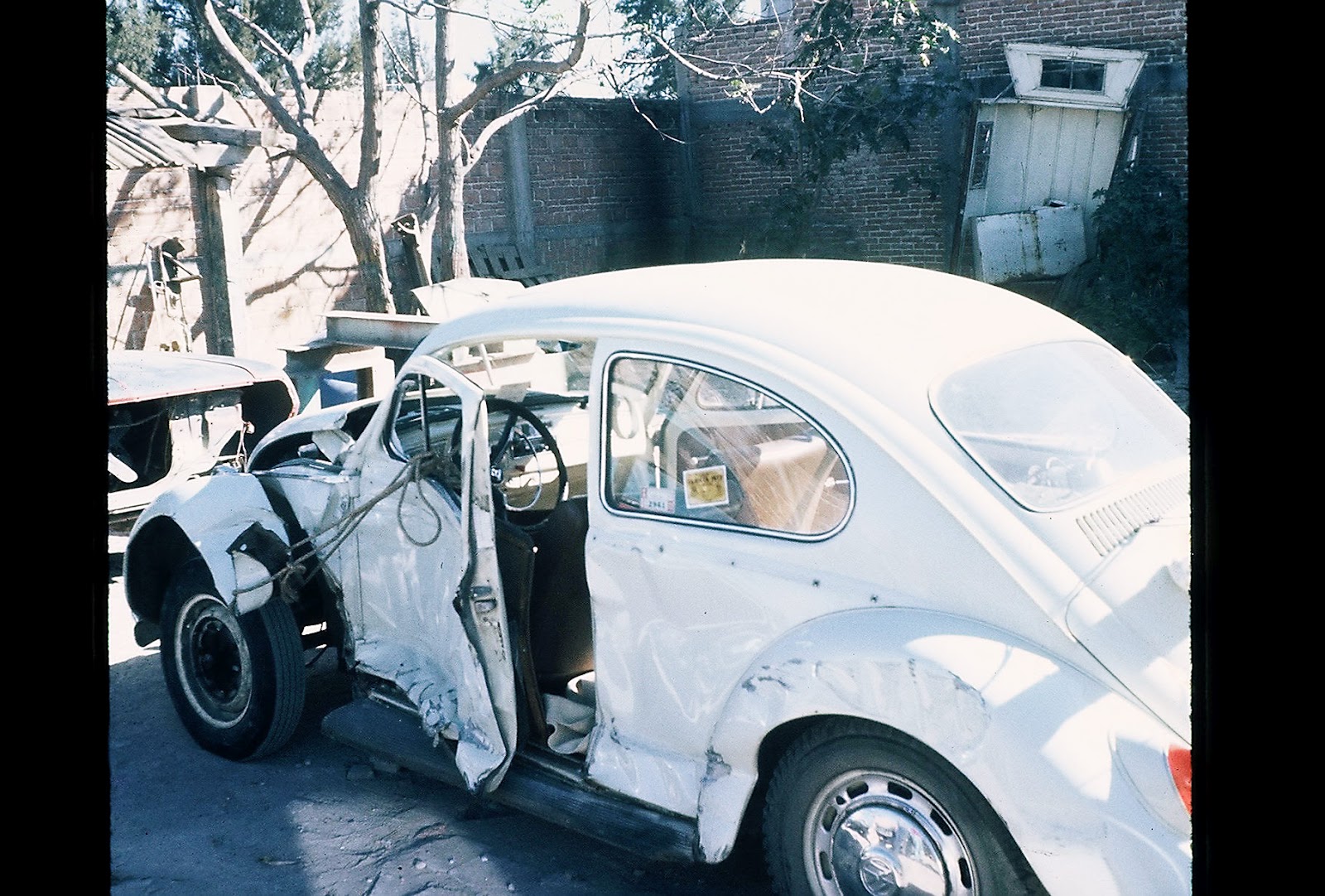
It was late afternoon, when Don, Gary and I were cruising the highway about 20 kilometers west of the south central agricultural city of Irapuato.  We were on our way to the west coast of Mexico and Don decided to make a left onto a dirt road to look for a place we might take a break and get a little something to eat.  As he started to make the turn, a bus traveling about 65 miles per hour, slammed into the side of Don’s Volkswagen bug.  We ended up landing on all four tires in a farmer’s field and the bus landed on its side in the ditch.

After cleaning all the shattered safety glass out of our mouths and hair, we looked at each other and discovered none of us had suffered any injuries except a couple of minor nicks where the flying safety glass had struck us.

I think Don could not believe we had suffered another car related set back and he wandered off saying he was going to call his dad.  That left Gary and me trying to understand a very agitated bus driver who was speaking so rapidly that we could not understand anything he was saying.

The people on the bus crawled out, apparently unharmed and before too long a young man walked up to where we were engaged in “conversation” with the driver, and inquired, in English, if we could use some help.  There are times in life when it would be nice to have a soundtrack and this was a time when glorious singing of angels would have been appropriate.

The young man was a college student going back to classes after a break.  Just as he was getting the driver calmed a bit, the owner of the bus line walked up and joined our little group.  He had been out for a Sunday afternoon pleasure drive with his family and had witnessed the accident. 

With the help of our student we quickly struck a deal with the owner of the bus line.  We agreed that each side would bear its own costs.  The bus company would tow our car to their mechanic’s lot and make their chief mechanic and his team available to us to repair our car.  We asked if the police needed to be called and the driver and the owner reacted with horror and quickly told us it was Sunday so they wouldn’t come out anyway.  Happy not to have to involve the authorities and feeling it was the best deal we could get (both sides shared the blame for the accident), Gary and I started looking around for Don.  A short time later he walked up and we explained the proposed deal to him and he quickly agreed.  The Volkswagen was then towed to the mechanics yard.  Our student stayed with us and found us an inexpensive clean hotel room in Irapuato.

El coche diablo blanco
The student told us that he would stay with an uncle who lived in town and would return the next morning with the bus line owner and pick up the chief mechanic and go to various junkyards to find the parts necessary to fix our car.

Bright and early the next morning we set out to pick up the mechanic.  First we went to his house where we were informed he hadn’t been home for a week and he was probably on a weeklong bender.  Next we went to the mechanic’s friend’s house and were told he had no idea where he was.  The bus line owner then tried the mechanic’s girlfriend’s house and after a short while he came out the front door, his hair sticking up in about a hundred directions, pulling a wife beater over his head.  He climbed into the backseat of the car.  I have to admit; our first glimpse of the guy who would put our car back together was not a confidence builder.

We drove back to the yard and Ramon, the mechanic, got out of the car and became all business.  He inspected the car, talked with his team and then crawled back into the car so we could start our junkyard tour.  We spent the rest of the day going to three or four junkyards where Ramon picked out fenders, a door and a hood along with a couple of smaller parts.

That evening as we sat in our hotel room there was a knock on the door.  There stood the bus line owner’s twelve-year-old son with his arms full of cans of beer.  He told us it was a gift from his father.

The next morning our student came by to say goodbye.  He needed to get back to school and felt we were now set up and didn’t need him any more.  How can you not love a country that produced so many people like this student?  With out him, who knows what would have happened?

That day we found out our destination on the west coast had been hit by a large earthquake, just about a couple hours after we would have arrived, and thousands of people were being fed out of mobile kitchens in the region.  In some strange way getting hit by a bus had been a stroke of luck.

We spent the next few days walking around Irapuato, reading and visiting with the bus line owner.  He had taken a shine to us and we were all becoming friends.  A couple nights after he had his son deliver beer to our room, his son showed up with a jug of tequila for us.  Most days we went down to Ramon’s yard to survey the progress on the car.

Ramon would greet us enthusiastically and show us what had been done to the car that day.  The three of us, proving we hadn’t missed our callings as either drug and alcohol counselors or social workers, agreed a good gift for Ramon was a nice bottle of tequila. Ramon seemed to greatly appreciate our thoughtfulness.

Finally, about a week after the accident, we were told the car would be ready at 5:00 pm the next day.  At the proscribed time we went to Ramon’s yard and there was the car looking about like it had looked before the bus smashed into it.  Don climbed in behind the wheel with the intent to drive the car to the end of the street and back as a test drive.  As he started out the rear wheels began to seriously wobble and we, along with the entire crew, ran after Don pleading with him to stop.  Someone had forgotten to tighten the lug nuts on the rear wheels.  Don stopped and this small problem was remedied.

The next day we left and they must have done a good job because we drove that car for several thousand more miles before Don got rid of it back in Green Bay.  Years later Irapuato became a sister city of Green Bay.  Judging by the people we met there it was a good choice.

---------------------------------------- 

Don, Gary and I left Irapuato and spent several weeks traveling up the west coast of Mexico.  When our money began to seriously run low (buying beer became a cost/benefit decision) we made our last stop in Guaymas, about 240 miles from the U.S. border.

Guaymas is located on the Gulf of California in the state of Senora.  It is a port city located in the Senora desert and in the early 19th century it was said to have gotten down to one resident.  Tio Pepe, a reputed drunkard and thief, apparently had the town to himself.  By the time we got there, it was in the beginning stages of a real estate boom fueled by gringos who could buy beach properties for a fraction of what they would have had to spend in California.

The beach we camped on had been the set for the movie Catch 22.  There were the remnants of a runway and various hospital and military buildings about three hundred yards from the beach.  Every time I see that movie, I look for all the places we roamed around while we were there.

Every day we were camped on that beach, the wind would come up around 4:00 and blow very hard for about 90 minutes.  Each day it would blow our tent down and we would have to pitch it again.  After the 90 minutes of wind it would calm down and the evenings were beautiful.

On our first full day there, we walked across the flat, hot surface of the desert back from the beach to the movie set.  The buildings were shells, of course, but their exteriors were largely intact.  While we were walking around treading the ground once walked by Alan Arkin and Art Garfunkel, I looked up and for a moment thought we had been transported into a Clint Eastwood spaghetti western.  Out across the arid, dusty landscape, heat waves radiating up from the ground, came four cowboys riding full tilt directly at us.

As we looked out at the riders, dozens of western movie images flashed through my mind, some of them quite unsettling.  As the riders rode up upon us in a cloud of dust, the wind that had started to blow, blew the leaders hat right off his head. It blew right by me and instinctively I stuck out my arm and the hat stuck in my hand.  I took the hat and gave it back to the lead rider and the whole posse grinned.

It turned out the cowboys had been hired by the people who owned the land to make sure people who camped on the beach didn’t use the lumber from the buildings for campfires.  They told us we were welcome to look around and go wherever we wanted to go, but were cautioned not to take any wood for our fire.  The sight of those riders coming at us full tilt was enough for me to keep my wood rustling urges under control and we avoided any frontier justice while we were camped there.

One afternoon, Don and I decided to go rock climbing.  For Don this was a logical decision.  He loved to climb, had an aptitude for climbing, had great upper body strength and was confident in his abilities.   For me it would be hard to count all the ways this was a stupid idea.  Let’s just go through the obvious reasons.  I had no climbing experience and what I did have proved I wasn’t any good at it.  As a kid I would usually outrun my mates to the fence but then spend so much time getting over it I would have to run like hell to catch up.  I had not yet worked as a trackman on the railroad and didn’t have a great deal of upper body strength to rely on.  I had absolutely zero climbing experience and we were going without ropes or any safety equipment whatsoever.  To fall was to die.  But what the heck, what possibly could go wrong?

Climb Site

Together we walked a footpath to its end and surveyed the bluff we intended to climb in order to reach the top of a ridge that ran to an easy walk down.  We started climbing together but soon got separated when Don took a route further up the bluff and I stayed to one more in the middle.  I climbed across the face of the bluff for a while until I came to a point where I wasn’t sure how to proceed.  I looked down at the rocks and the surf below me and quickly concluded I better not make any mistakes.  As I clung to the face of the bluff, my options seemed very limited.  In fact I didn’t see anyway to move safely, including back the way I had come.  As the fear started to settle into the pit of my stomach, I decided that I had indeed gotten to this point and that my only viable option was to try and retrace the way I had come.  Slowly, and I do mean slowly, I worked my way back, pretty much the way I had come.  All ten fingers were bleeding and both knees were scratched up by the time I reached a safe place.  The funny thing was that I hadn’t felt anything until I was walking back on the footpath and noticed the blood. I met up with Don, who had climbed across his northern route without any trouble and we walked back to camp. 

That night a diamond driller from either Australia or South Africa (I can’t recall which of these two locations he was from) and his girl friend camped next to us on the beach.  He went into town and bought a couple of chickens and a case of beer and turned a night that had promised to be quite austere (we really were out of money by then) into a small party under the stars.   I kept thinking what might have been and was truly happy to be on that beach in one piece. The next day we drove to the border and reentered the United States.


Sunday, February 12, 2012

The Birth of the Flash Mob


Recently I was noodling around the Internet when I came upon a video of a flash mob that was pulled off by a group on University of Minnesota music students.  Later that evening, after a couple of beers, it dawned on me that I and about nine other Green Bay fifteen year olds had invented the flash mob in 1967.  Please stop rolling your eyes and sighing and reserve judgment until you read the rest of this post.  Once you read the whole story, I think, you will agree with me, that I am owed royalties from everyone who has ever planned, participated in, or witnessed a flash mob.
1967 was a heck of a year in the good old U.S. of A.  Race riots erupted in Buffalo, Detroit, Minneapolis, Milwaukee, Newark, Tampa, and Washington D.C.  Martin Luther King publically denounced the Vietnam War and Muhammad Ali refused induction into the military.  Large scale anti Vietnam War protest were held on both coasts and the students at Cheyney State, the oldest African-American institution of higher learning, took over their university.  The Dow Chemical protests broke out on the campus of the University of Wisconsin – Madison signaling the beginning of years of radical anti war protests.  The first “Be – Ins” were held in San Francisco and New York and San Francisco’s “Summer of Love” blossomed in and around Golden Gate Park.  It is safe to say the country was experiencing a certain level of turmoil.
Not so much Green Bay.  The city’s entire African American population was fully engaged with Vince Lombardi in winning the Ice and Super Bowls.  The University of Wisconsin-Green Bay was just in the process of becoming a four-year institution and the anti-war movement was pretty much a guy named Bob, who used to banter with my mother on our driveway after he walked home from high school with my brother.  However, to paraphrase Bob Dylan, we knew something was happening out there, but we didn’t know what it was.  I don’t think the flash mob would have been birthed outside the context of our shared national experience.
In mid-September of 1967 I began going down to Tower Park after dinner to sit with a group of 15 year olds and shoot the breeze.  I wasn’t really friends with these guys but was accepted, probably because I could be a little funny once in a while and they just didn’t care one way or the other.  The collective reputation of this group wasn’t great but our activities at the park were pretty benign.
Tower Park was about two blocks from my house and the entire park was about a third of a small city block.  The park got its name from an old water tower that stood in the back right hand corner of the park.  On two sides of the park there was a two and a half foot stone wall that we would sit on when we gathered.  Across the street was a small store that featured “penny candy” and canned goods that had been on the shelves since the Korean War.  Next door was a dairy store and across the street was a small drug store, realty office and a barbershop.
The local merchants weren’t crazy about having us there but we never really did anything that could hurt their business so there was an uneasy truce between us.  Sure, once in a while we would see an older brother of a kid we knew drive up and run in and get something from one of the stores.  All nine or ten of us would pile into his car and refuse to get out until he drove us where we wanted to go.  No one seemed to resent these types of things all that much and usually the “victim” would end up having a good time driving us to wherever we wanted to go.
One other time one of the neighbors talked to us about being loud and using foul language.  To our credit, we took that complaint seriously and self policed ourselves when things got loud or someone forgot and got too profane.  By and large, it was a peaceful, if uneasy, co-existence.
About twice a week a kid named Nick would join us and was dubbed our leader.  Nick was a troubled kid.  I first met him when we were seven years old.  I was standing in my front yard drinking a coke when Nick walked up with a live snake in one hand and asked for a drink of my coke.  I wasn’t inclined to share because I didn’t know Nick that well, but more importantly, he had a very obvious mucus problem going on.  When I refused, Nick asked me if I would change my mind if he put the snake he was carrying in his mouth.  This didn’t seem to sweeten the pot very much, so again, I told him no.  He put the snake in his mouth and then demanded I give him a drink.  We ended up in a fight that ended with him going home crying.
Between the age of seven and fifteen, Nick fell in with a group of older guys that would probably be described today, as skinheads.  Nick did a lot of weight training and they taught him to fight and by the time he was fifteen he was one of the toughest kids around, if not the toughest.  I was always grateful that he never sought revenge for our earlier fight because I would have ended up a bloody mess.
Nick was the best dressed fifteen year old in the city.  A typical outfit would be dark dress pants with a knife edged crease, spit shined shoes, a starched button down dress shirt and an Arnold Palmer cardigan sweater.  He always looked like he was going to meet up with the Rat Pack and do Vegas up right.
When he did come down to the park he would pace back and forth in front of us and expound on whatever was on his mind.  We, his audience, would insult him, his ideas and even his clothes.  He would feign outrage with a goofy grin on his face and everyone would have a good time with it.  None of us would have dared to talk to him that way under normal circumstances but he seemed to really enjoy the give and take and his unofficial designation as our leader.
One Tuesday evening, someone, and I don’t remember who, said we should have a rally.  The idea was that we would tell everyone we knew to meet in the park at 6:00pm on a certain day.  That was the entire agenda. Just show up. There wasn’t any other plan then to meet next Tuesday in Tower Park.  Then in a true stroke of genius, someone suggested we call it the “Tower Power Rally.”
All the next week we would greet each other with “Tower Power” and a closed fist salute, held shoulder high.  This was years before social media made it possible to spread a message far and wide almost immediately.  All notice of the Tower Power Rally was done face to face, one attendee at a time.
As the day approached, none of us knew what to expect.  We were hoping to get a few laughs out it and really didn’t spend much time discussing what was going to happen.  We had no agenda and no idea how many kids would take the trip down to the park.
On the evening of the rally, I went to my bedroom after dinner to choose my footwear for the evening.  Somehow subliminally, I knew running might be in the cards so I selected a pair of low cut black Chuck Taylor All Star basketball shoes.
I was always a punctual kid, a legacy bequeathed me by my father, and was one of the first to arrive.  As I was sitting on the wall kids started to trickle into the park.  Before long, all of the regulars came and were joined by about 50 other kids.  The neighborhood merchants came out in front of their stores and eyed us warily.
At some point someone asked: “Where’s Nick?  We need our leader.”  Nick lived about two blocks from the park and it was decided that the now, sixty or seventy kids would walk over to his house and bring him back to the park.  As we filled the sidewalks and spilled into the street, neighbors drew their blinds and peeked out from behind their drapes.
Nick’s house was one of those tiny houses that sit at the back of a long skinny lot.  When we arrived we filled the front yard and spilled across the sidewalk into the street.  A chant went up from the crowd:  “We want Nick!  We want Nick!”  Eventually Nick came out on his front porch holding a dishtowel in one hand.  His tiny four foot something mother was right behind him.  As Nick appeared the crowd roared and the chant grew loader.  Nick’s mother addressed the crowd saying he could not come out that night because he had to finish drying the dishes.  The crowd rained boos down on the little woman.  Nick spread his arms out, embracing us all, and said, “Ma, my people.  They need me.”  The crowd roared.  Nick’s mom then grabbed on to his arm to physically restrain him from leaving the porch.  Nick finally gave in to parental guidance and went back in the house, presumably to finish drying the dishes.
It was a good thing that Nick’s mom had the courage to stand up to the mob.  She knew Nick was always one incident away from being committed to the Boy’s School in Wales WI (read prison) and the last thing she was going to let happen was to let Nick go down to the park and ”lead his people.”
.
Having failed to shake Nick loose from that ferocious maternal grasp, the kids walked back to the park.  When we got there, the crowd had tripled.  Adding to the spectacle was the younger neighborhood kids, who were riding their bikes around the edges of the crowd.  After all, this was the height of the baby boom and every neighborhood had about eight gazillion kids.
Kids were sitting on every square inch of the stone wall and standing in groups throughout the park.  Every bus that stopped at the corner by the park burped forth more kids from all parts of the city.
As dusk began to fall, people started talking about leaving.  All of a sudden, a bevy of police cars, lights flashing and sirens screaming descended on the park from all directions.  A paddy wagon pulled up and stopped right in front of where we usually sat.  The place took on a surreal feel.
I began to examine my escape routes and determined I was in a good enough position to stick around and watch what was unfolding for a little while.  My friend Don (Uncle Don) was late getting to the Park because he had football practice.  He had arrived about a minute before the cops showed up.  I watched as he was ushered into the paddy wagon.  Later he told me a cop had asked him what he was grinning at and when he was unable to give an appropriate response, he was given a ride downtown.
Kids scattered in all directions and the police grabbed as many as they could.  I took off through a back yard with a friend and we were making our way back to my house when a police car came screeching around the corner and a cop began running toward us.  We took off and this is where my choice of footwear paid off.  My friend had chosen the more stylish penny loafer without socks look and as he took off one of his shoes didn’t go with him.  The cop was able to grab him and he received a free ride downtown.
When I got home I grabbed the basketball and began to shoot baskets on the driveway.  Before long kids making there way out of the dragnet joined me and soon we had a game of fifteen on fifteen going.  This drew my mother’s attention, as she knew I wasn’t anywhere near that popular, and she stuck her head out the back door and asked what was going on.   I told her something was happening at Tower Park and we were playing basketball and staying out of trouble.  Apparently satisfied, she went back in the house.
After a little while I walked down to the corner where the police had barricaded the street and innocently asked the cop standing there what was happening.  He told me it was none of my business and I should get my ass home as fast as I could.  While I was there, I heard his radio crackle to life and a slightly apprehensive voice say, “They are coming from all over.”
I walked back to the house and played a little basketball.  Before long everyone went on their way and I went in the house.  The Tower Power rally was over.
The next day our gym class teachers lined us up at attention in military fashion and walked around like Colonel Klink and Sergeant Schultz sticking their faces close to the usual suspects’ mugs and sneering  “Tower Power aay.”  We all used our well-practiced, blandly innocent looks and the matter was dropped after a couple of days.  There was nothing to pursue anyway.  There had been no property damage and no laws had been broken.  All we had done was exercise our right to free assembly and invent the flash mob in the process.
So that’s my case for claiming credit for inventing the flash mob.   Sure there have been enhancements since 1967, but any fair person would agree that my claim for royalties is justified.  So if you have planned, participated in, or seen a flash mob please send me a onetime royalty payment of $17.95.  If one gullible person sends me the money, I will buy a case of beer with it.  Think of it as an investment.  Imagine what else I might invent after a few more beers.


Saturday, January 21, 2012

Sketches of Mexico


During parts of 1959 and 1960 Gil Evans and Miles Davis combined their immense talents and made a recording they called Sketches of Spain.  When I first bought it I thought the music was hauntingly beautiful but I didn’t fully appreciate their accomplishment until I listened to the recording after returning from a visit to Spain.   What I had missed the first time was how the music evoked the sound and feel of the country.  The music was not only beautiful but it had somehow captured the essence of Spain.
I traveled to Mexico for the first time about 40 years ago and have returned many times over the years.  Mexico has surely left its mark on my and my family’s lives.  In this post I am going to attempt to convey what it is about Mexico that originally intrigued and charmed me and why it has become so important in my life.  The following “sketches” are but a tiny slice of that experience.  Please ignore the whirring sound as you read this post.  It’s just Evans and Davis spinning in their graves.
The saying goes “Ignorance is Bliss.”   Most of the time ignorance is ugly and sometimes dangerous.  But when Mary, Pat and I travelled to Veracruz on the Gulf Coast of Mexico in the early seventies the saying held up.  As we blissfully made our way to Veracruz, we were unaware that about a half of million other souls were also making the same trip to the largest carnival in Latin America outside of Brazil.
Remarkably, when we hit town we went to the first hotel that looked like it would be in our price range and procured a big clean room about a block and a half from the center of downtown.  At that point we had no idea the demand for rooms was way beyond the city’s supply.  I still don’t know how we lucked into that room, let alone in that location.
Our hotel was just up the road from the Zócalo (town square) that was ground zero for the carnival.  The square was full of restaurants and taverns featuring outside dining and drinking and providing ringside seats for the carnival’s chaotic explosion of humanity.  When we left our hotel room and wandered down to the Zócalo we began to get some idea of the scope of the event that was happening around us.
The carnival was a nighttime affair.  I remember going down to the Zócalo and grabbing a table at one of the bars around 5:00pm.  You could still get a seat then but within an hour the square was packed.  I would order a beer and it would come in a schooner so large that when you tipped it to drink, it was like you were looking across a lake of beer to the other side.  That first beer would cost 5 pesos and each beer thereafter got more expensive.  By the time you got to the 12 peso beers you could see pirate ships and surfers and all sorts of things when you looked across that lake of beer.
Sitting at those tables exposed you to numerous vendors selling all kinds of cheap crap and kids who found it extremely entertaining to throw handfuls of confetti all over you.  They took particular delight in bombing gringos and we found those little pieces of paper in our shoes and clothes for weeks after we left Veracruz. 
One particular type of vendor caught my eye because I couldn’t tell what it was he was selling.  The vendor had a box with two cords coming out of it and a metal handle at the end of each cord.  The vendor would clink the handles together as he walked through the crowd and occasionally stop at a table of presumed customers.
One night as Mary, Pat and I sat at a table a young man at an adjacent table positioned himself so he was looking directly at one of my companions.  In his hands he had the metal handles and one of these mystery vendors was standing next to his table with the box in his hand.  As it turned out, the box contained a big battery and had a dial on it that allowed the vendor to control how big of shock he was delivering to his customer.  That’s right, these guys were paying someone for the privilege of being electrocuted in an attempt to prove who was mas macho.  It sounds like a Newt Gingrich idea for prison reform, but that, in fact, was what was going on.
As the vendor turned the dial the young man’s mouth turned into a grotesque cross between a grimace and a grin.  His eyes bulged and veins popped out on his forehead.  Just about when it looked as if his hair would go up in flames he signaled the vendor and the juice was cutoff.  Then he looked at Pat and Mary with a “what did you think of that display” look.  Now I am no expert on what woman find attractive in a man but I have to believe seeing a guy being electrocuted, as a first impression, isn’t likely to be near the top of the list.  During the course of the night one or two other guys tried to spark an attraction in the same way without success.
One night I was sitting at a table drinking beer with a Canadian I had met the day before. As we progressed to about the eight peso beers a Mexican friend of the Canadian joined us.  As it turned out the Mexican fellow was a shock box vendor and my Canadian friend asked him if he would let me try the box free of charge.  I resisted that kind offer but when it came up again at about the 10 peso beer mark, I agreed to give it try.
Before we started I tried to set some ground rules.  Primarily I wanted only the wimp equivalent of electricity and I wanted it shut down as soon as I signaled I’d had enough.  So with those rules in place, I grabbed the metal handles for my free shock treatment.
He turned on the box and I just about went into cardiac arrest.  Now, you only have to have a very rudimentary knowledge of science to know that when you are part of an electronic current there is no letting go.  A lesser-known scientific fact is that verbal communication becomes much more difficult when you are being lit up.  As I tried to indicate he should turn the damn thing off, the signals got mixed up and he turned up the juice.  I had visions of smoke coming out my ears as I began to shriek my desire to be done with my free sample.   I’ll never know if there was a miscommunication or if the vendor thought “let’s see what this gringo’s got” but he cut the electricity.  I do know the Canadian was greatly amused.  Later that evening when Pat and Mary joined me, I wasn’t sure if they found me more attractive for having gone through the experience or more likely thought “what an idiot.”
We stayed in Veracruz for four days and nights and left completely carnivaled-out and headed to a beautiful freshwater lake where we had a close encounter with a huge bull.  But that’s a story for another time.
A more modern of the 'Quién es más macho?' box.  Newer packaging, same concept.
---------------------
In 1972 Gary, Don and I were driving down the Pan American Highway in an old Volkswagen approaching Mexico City.  The Pan American Highway is a 27,000 mile roadway that runs from North America through Central and South America with one 54-mile break in a Panamanian rainforest.  It is considered one of the engineering wonders of the world. 
As we entered the outskirts of Mexico City the car broke down in a very poor neighborhood.  We instantly realized that this was going to pose serious logistical problems, mainly because none of us spoke any Spanish.  Gary had taken a semester or two of Spanish in high school but I think he probably spent more time spoofing his teacher, Senor Statz, than actually learning any Spanish.  We did bring a phrase book with us and armed with that, Gary walked down to a corner pharmacy to try to call a Volkswagen dealership.
After miraculously connecting with the dealership, Gary tried to convey our problem.  Consulting the phrase book, he told the unfortunate person on the other end of the line that “El coche is rrrroto”, trilling his r like Salvador Dali on LSD.  This helpful phrase let the dealership know that the car was broken but nothing else they may need to know to help us out.  Gary repeated his phrase two or three times when the pharmacy clerk took pity on us, took the phone and explained the situation.  The clerk hung up and let us know they were sending a truck to tow us to the dealership.  When it would come was anyone’s guess.
The distribution of wealth in Latin American cities is the exact opposite of U.S. cities.  In Latin America the wealthy live in the center of the city and the further out you go the poorer the neighborhood.  Mexico City had about 12 million people at that time (now about 25 million) and we were broken down out on the edge of those twelve million.
It was around 1:00pm when we went back to the car and commenced our wait.  As we sat there the neighborhood kids started to appear.  This wasn’t exactly the gringo trail and it’s my guess that we may have been the first U.S. citizens most of these kids had ever seen.  Forty years ago, the size differential between Mexicans and people from the states was very pronounced.  Don was six foot one or two and had blond hair and blue eyes, so he drew the most attention.  It being the early seventies, we all had long hair and as the kids got bolder they would sneak up behind us and give a little tug on a pony tail and then run away laughing.  We began to play with them, chasing them around the car and having a good time relieving the boredom of waiting on a dirt street in the tropical sun.
Pretty soon after we began to run around with the kids, a mother came out with three oranges cut in half on a plate and gave them to us.  These were people who, I am sure, had a hard time feeding their families sufficiently, and sending out oranges to three strangers struck me as an extremely generous and gracious gesture.
As the afternoon dragged on, a young girl came out and through hand signals and the phrase book, we figured out we were being invited to dinner with her family.  We followed her to her house and entered a tiny dwelling.  We were introduced to her mother and her brothers and sisters and sat down in the main room.  There were two pictures on the wall.  One was of the current pope.  The other was a picture of JFK that had been cut out of a newspaper.  I have mixed feelings about JFK’s legacy but he obviously meant something to these poor people in another country.
The mother and oldest daughter approached us about what they were having for dinner and despite all of our efforts, we did not understand each other.  Then the mother got an idea and left to go to the kitchen area and returned with a birdcage with a nest in it.  In the nest were a few eggs and we realize what she had been trying to covey and learned huevos was Spanish for eggs.  This was long before huevos became slang in the U.S. for something unrelated to diet.  We nodded our approval the mother headed back to the kitchen.
Shortly thereafter, the father of the family came home.  His wife explained the situation and he came over and shook all of our hands.  He then called one of his daughters, who was about 8 years old, and spoke with her briefly.  A moment later, the daughter appeared before us with her reader from school, and began to read haltingly, a story in English.  When she finished we applauded and told her how good she had done.  While the daughter was obviously pleased with our reaction, it was the pride and love reflected on the father’s face I will always remember.
We then sat down to a dinner of eggs and tortillas with a side of mole.  This was the first time I had ever seen mole and I have to admit I was a little reluctant to put this stuff in my mouth.  I have since found out there are a million recipes for mole and they range in taste from delicious to road tar.
The mother noticed my reluctance and asked me if I didn’t like mole.  I figured I better try everything these good people had put before us and I put some on a tortilla and shoved it in my mouth.  The look on my face (this recipe was closer to the road tar end of the spectrum) resulted in a burst of laughter from the whole family.
Not long after we finished dinner there was a commotion outside and we discovered the tow truck had arrived.  We said our goodbyes and rode with the truck into Mexico City proper.  A day later the car was fixed and we were on our way again.
This was the first of many times Mexican people have showed me and my travelling companions extraordinary kindness.  I have found, by and large, the Mexicans to be gracious and generous to the people who have chosen to travel in their country.  These economically disadvantaged people had gone out of their way to make us feel welcome and to turn what might have been a tedious experience into a memorable one.
--------------------
There are at least three types of daylight you experience in Mexico.  There is the morning daylight I liken to a nice warm summer day in the northern U.S.  Then there is the mid-day light. This is the true tropical white light that you feel right down in your bones.  My favorite is the light that comes with late afternoon.  The heat dissipates and the light defuses as the sun and sky begin to change colors.  It was in this type of light, that Mary, Pat and I experienced the joys of “hillbilly hand fishing.”

The light I love.
We were camping in a coconut grove about two hundred miles south of Acapulco.  We had arrived at Puerto Angel on the west coast of Mexico one night after a crazy ride with a deranged gringo.  The coconut grove was about a kilometer north of the village and we walked there and pitched our tents.  Not long after we pitched our tents an Indian woman came by to collect eight pesos rent (about $1 dollar at that time).  We ended up staying there for two weeks and never saw the woman who collected the eight pesos rent again.
The grove was large with very tall, fully mature coconut trees.  There were several groups of Americans and Canadians camped in the grove.  Where the grove ended the beach began and there was about 50 yards of beach leading up to the pounding surf.  This surf was not one to be taken lightly.  There was a serious undertow and one had to be careful not to get dragged out to sea and drowned.  As it sometimes happens, dangerous things are also the most beautiful things. That was the case here.  The area also featured a waterfall about two kilometers inland were we could shower in gloriously cool fresh water.
The closest village consisted of two lean-to restaurants on a bluff overlooking the ocean, whose menus consisted of whatever was available that day.  One day eggs, the next day fish.  Out in the yard there were a couple of hammocks.  I remember whiling away a couple afternoons reading Herman Melville’s Encantadas, taking the occasional break to gaze out at the Pacific and imagine sailing ships plying the Spanish Main.
One late afternoon, as Mary, Pat and I returned from a trip into Puerto Angel, we looked out at the ocean and saw three people running madly around in the surf.  As this behavior continued we decided to walk down and see what was causing the commotion.  As we approached the water we saw the three people catching fish by hand and tossing them onto the beach.  So we joined in and began chasing these twelve to fifteen inch blue fish in the surf.  The drill was to chase a fish and reach down at the right time and grab it and throw it on the beach.  A whole school of these fish were swimming in two feet of water and it really wasn’t very hard to catch them.  It occurred to me later that maybe something much bigger and meaner might have driven that school of blue fish into the surf and it might not have been such a good idea running around sharing its catch.
We did catch 39 fish between the three of us.  We combined our catch with the other fisherman’s and someone ran up into the grove and returned with a tablecloth size piece of material to pile the fish in and carry them to the grove.
Once we got there word spread quickly and out of nowhere the locals came and built several campfires.  They also brought frying pans, butter, tortillas and other fixings.  The party was on.  After we ate the fish we had caught about 45 minutes earlier, the guitars, beer, and tequila arrived.  As we sat in that coconut grove, under a canopy of a billion stars, I couldn’t imagine any place I would have rather been at that moment.
And so concludes my “Sketches of Mexico.” These three stories are just the tip of the iceberg and maybe I will someday post a Sketches of Mexico Part Two.  Right now I need to run out and once again prove: "Quién es más Macho?"


Thursday, January 5, 2012

Where to Begin? How to End?

I had originally thought to write about my own students’ creativity as a continuation of the grouch’s last post, but then it occurred to me that while my father and his friends’ creative genius stems from boredom and deeply entrenched delinquent tendencies, the creativity my students exhibit is a lesson in survival and coping strategies.  For example, one of my students showed me how a cheap flip flop can double as an eraser, a trick he picked up in a refugee camp in Thailand.  Another student of mine uses a clear, plastic water bottle as a pencil case.  All of my students are tri-lingual, their native language (Spanish, Somali, Hmong, Oromo, Vietnamese, French, etc), English and a code-switching blend of the two a la Spanglish which they use whenever they can’t quite find the right word in either ‘official’ language.  I even have one native Oromo speaking student who, being the only non-Spanish speaker in a class of 12, has started to learn Spanish and now uses it at home and in his other classes when he feels it to be the best way to express himself.


My kids are great.  Whenever anyone asks how my first year in Minneapolis is going, my first response is how lucky I got when it comes to my kids.  They can be stinkers, of course, it is middle school after all, but in general they are respectful, dedicated kids who are willing to work with each other and me.  And from talking to other teachers and my past experience with less cooperative groups, I know what a difference a good group of kids make.  All that being said, my kids being stupendous and adding in excellent co-workers (yes, I’m bragging, it’s my blog, so what?), I’m STILL not ready for winter break to be over! 

Alas, 4 more days and I’ll be back in the classroom and that is why it’s imperative that I write this blog now.  Not that I have a whole lot of important things to say, but I’ve been informed that I’m falling down on the blog job and that I need to pick it up.   So here you are, you asked for it!

Pako and I arrived in Zihua on Christmas day; a whopping 3 months and 8 days after Pako entered the United States.  At the beginning, he felt a little silly coming back already, but it didn’t take long for him to develop a perma-grin that hasn’t left his face yet.  (I have a sneaking suspicion that I know when it will leave his face, but that sort of thinking is pessimistic and those of you who know me well know that I’m the consummate optimist…).  Pako’s sister, Lorena, and her husband, Tito, met us at the airport with our 3.5-month-old niece, Leah Elizabeth.  Yes, she is named after me, and no, it’s not a coincidence that she is the most beautiful thing I ever did see.  She also happens to be incredibly strong (she can almost stand on her own!) and completely mellow and happy and easy-going.  Just like her aunt (I’m also almost able to stand on my own… any day now).  Since we’ve been here, we’ve spent as much time with her as possible (and the rest of the family as well, but who are we kidding, there’s no competition between the world’s cutest, happiest baby and a bunch of adults) and Pako stood up as her godfather when she was baptized.  (I couldn’t be the godmother as I am an un-baptized heathen, but she’s got my name, so really, who is winning this game?) 
Don't even try to tell me this isn't the most adorable baby you ever saw!  She's wearing a party dress to boot!

We’ve visited a lot of friends and family, eaten a lot (too much) of good food, spent many a happy hours at the beach (Pako on his board and me on the beach with my books) and tried to soak up as much warm weather as possible since we’ve been here.  At one point, during our first week here, I mentioned to Pako that I missed my parents (awwwww) and Pako said, “me too.”  And THEN he said, “I miss Minnesota,” and I almost broke my neck I whipped my head around so fast to see if he had actually said that or if I had had some sort of hallucination due to too much sun and beer, but no, he actually said that he missed Minnesota.  Poor guy, he’s clearly taken too many direct UV rays, but it was cute and warmed my heart as I do worry about him moving from such a paradisiacal place like Zihua to… Minnesota.  No, I’m not down on Minnesota after such a short time spent back in the States, but I am also not blind or without a sense of temperature.  Plus, it has only snowed once and our coldest temperature was still way above 0, so the poor guy knows not what he speaks.

Now that our time is quickly waning and it’s clear that we won’t be able to do everything we want to, we’re both starting to feel the weight returning to our shoulders.  By the weight, I mean of course, the real world of 12-hour workdays, shoes and socks and scarves and mittens, and grey slush.  Ugh.  Sigh.  Ugh again.  I definitely feel like we’re destined to always have the vague sense that we’re really meant to be somewhere else, one foot in Minneapolis and one foot in Zihua.  It’s not fair really, because it’s hard to feel completely satisfied with our lives in either place, but it’s also extremely cool to have two places to come home to, two families to welcome us and two cultures to embrace.

As it is a new year and all (though I’m sure I’ll write 2011 on checks for at least another month or so), Pako and I have been talking about plans and dreams and goals for the future.  We don’t have anything concrete and certainly no definite timelines (Pako is Mexican after all and time in his culture is relative), but we know we want to buy a house in Minneapolis, a vehicle (though to hear Pako talk, we want to buy a truck and 3 different cars that can fulfill any possible transportation need), a piece of land here in Zihua on which to eventually build a house, a dog (or, again according to Pako, 7 dogs and 2 cats and a bird), we want to both work in schools so that we have the summers to spend with our family here in Mexico and eventually (but VERY eventually) we want to have a baby or two (not at the same time, knock on wood!!!).  Who knows which of those things will come to pass in 2012 or at all, for that matter, but it’s what is on our mental list of things to do when we’re grown ups (so not for awhile yet, I guess).

I’m not entirely sure how to end this blog as I’m not entirely sure what I have rattled on about up to this point, but end I must.  This Saturday we are having a small memorial toast to our friend, Jim Nelson, who passed this past August.  Jim played no small role in turning Zihua into a place that felt like home for me and I definitely notice a shift in my perception now that he’s not here.  I know I’ve said it here before, but he was a wonderful man and he is sorely missed.  Multiple times a day I find myself thinking:  Jim would love this!  Especially when it comes to Leah Elizabeth aka Betty (after Jim’s wife) because he would of loved her and she, him.  It’s still hard to believe that he’s really gone, but I look forward to the opportunity to celebrate his life with a group of people who knew and loved him like we did. 
Jim and us at our wedding, Feb 2011
Jim and us, right before he drove back to Vancouver, Feb 2011

So, who knows when I’ll be back, but the grouch has musings on many things that he’ll no doubt want to share with you all sometime soon. 

Until then, Feliz Año!