Wednesday, September 26, 2012

Gunsmoke: Then and Now


I have to confess, I’ve always had a weakness for a good horse opera.  There was something about the wide-open range, good versus evil, horses as transportation and a cowboy’s best friend that appealed to me as a small boy.

I was lucky to have grown up during TV’s golden age of Westerns.  Every week, I could watch Gunsmoke, Bonanza, Rawhide, The Rifleman, Have Gun: Will Travel, The Rebel, Wagon Train, The Big Valley, The Wild, Wild West, and I’m sure a couple others I have forgotten.  My grandfather’s favorite was Gunsmoke and most weeks we would all watch it together and let our imaginations roam with Matt, Doc Adams, Kitty and Festus.
Matt, Festus, Doc and Kitty
Now, thanks to a retro television station, I am able to once again watch Gunsmoke every weekday at noon as I eat my lunch.  As I began to watch the show again, I realized that each episode is a small morality play and many issues of the day were addressed as life was depicted in Dodge City each week.  As I watched the show, I began to think how different the show might be if it was written today.  The following is a description of certain story lines I have seen over lunch lately and how I think they may have differed if they were written today.

THEN:  The son of a small rancher, whose go-it-alone attitude and suspicion of his neighbors has isolated him from the people of the greater Dodge City area, falls down a well and is injured.  The rancher resists his wife’s pleas for him to seek help and tries to rescue the boy alone.  His neighbor, who is unaware of the situation, is out dynamiting stumps, which results in the well partially caving in and further injuring the boy.

As things go from bad to worse, Matt and Festus stop at the ranch to water their horses.  When they discover what has happened, Matt sends Festus back to town to round up shovels, picks, wheelbarrows and volunteers willing to help rescue the boy before the rest of the well caves and buries him.  Festus races to town and gathers up the necessary tools and a large group of townspeople who race back to the ranch.

The rescuers all pitch in and are able to bring the boy up just before the well collapses entirely.  Doc Adams has the boy carried to the ranch house where he treats his injuries, thus setting up a winning situation for everyone involved.  The boy wins because he lives.  The Rancher wins because he learns a valuable lesson about community and cooperation that is reinforced every time he looks at his son’s smiling face.  The town’s people win because they have that special feeling that comes from knowing their combined efforts have saved the life of a small boy.  This wasn’t in the script, but I bet they went back to town and had a square dance with Festus doing the calling.

NOW:  The boy falls in the well and the small rancher tries to rescue him by himself.  The neighbor, unaware that anything has happened, continues to dynamite tree stumps and the well partially caves in.  Matt and Festus stop by to water their horses and Matt sends Festus back to town to get help.

As Festus gathers a crowd of townspeople around him, he finds a certain reluctance of the townspeople to rush off and help this rancher that no one really knows.  Doc Adams joins the crowd and asks what type of health insurance does the boy carry and when he is told the boy has no coverage, he is hesitant to join the rescue party.  When Festus asks if Doc is just going to let the boy die, a member of the crowd shouts, “let him die” while others cheer.

Doc decides to stay in Dodge and the response from the town is limited and weak.  The well caves in before the boy can be rescued.  The boy dies a free man.

THEN:  Dry conditions are putting pressure on small ranchers and federal lands are opened up so the cattlemen can find land to graze their herds. The Cattleman’s Association, which is made up of the three largest ranches in the area, hires gunmen to limit access to the federal land to the members of their Association.  The head of the Association justifies their action by saying they need to keep outsiders from Texas from over grazing the land.  Festus tells one of the big ranchers that what they are really doing is using their power to restrict use of the land for themselves when it should be open to everyone.

Tensions grow as the small rancher’s cattle begin to die and they clash with the Association’s hired guns.  Matt and Festus form a small posse and, together, they defeat the gunmen and open the land to all.
Government Employees

NOW:  The dry conditions pit the Cattleman’s Association against the small ranchers over the use of federal grazing land.  When Matt and Festus try to make sure all citizens have equal access to the range, the Cattleman’s Association organizes a wagon train of people carrying signs that say, “keep your government hands off federal land,” demand Matt and Festus stop impeding the job creators and stay out of this fight.  The Cattleman’s Association promises a new round of campaign contributions to Kansas’ senators and congressman and a new law is passed restricting use of the federal land while excepting large operations.

The small ranchers go bust and their land is bought up by members of the Cattleman’s Association for a pittance.  The small operators and their families drift off the land and into the slums of the big cites where many of them die from causes linked to poverty.  They die free men and women.

THEN:  Three desperados kidnap Kitty in a plot to lure Matt into a trap.  The leader of the bad guys is seeking revenge against Matt, for apprehending his brother, who was eventually hanged for murder.  Kitty is held in an old abandoned ranch house where she is beaten and abused.  The leader stops his two partners from raping Kitty, telling them there will be plenty of time for that after they kill Matt.
Waton Woman?
When Matt finds out Kitty is missing, he puts Festus in charge of Dodge, and rides out to find his main squeeze.  Festus argues with Matt about going with him but Matt needs Festus in Dodge because a bunch of drovers are coming to town and the usual fist fighting, drinking and shooting is expected.

Matt tracks the thugs to the abandoned ranch.  During the ensuing shootout, Matt is winged (marking the 400th time Matt has been “winged” during the 20 year run of the show), but manages to kill two of the crooks and capture the third.  Kitty, beaten and terrorized, is rescued before she has to endure even worse treatment.  Doc treats Matt’s latest gunshot wound and the third kidnapper is tried and sentenced to a long prison term.

NOW:  Three desperados kidnap Kitty in a plot to lure Matt to her rescue so they can kill him.  Kitty is beaten and terrorized but the leader stops his two henchmen from raping her until after Matt is killed.

When Matt finds out Kitty is missing he is torn between staying in town to protect it from the drovers and going immediately to find Kitty.  Normally he would put Festus in charge but Festus was laid off the previous month because government workers, like federal deputies, are judged to be over paid, entitled symptoms of a bloated government.  Matt decides to stay in town for as long as necessary to protect the town he is sworn to serve.

When Matt doesn’t show up to rescue Kitty right away, the leader of the gang cannot stop his underlings from raping and further terrorizing her.

After a long weekend of busting up fist fights, disarming drunks and filling the town jail with drunken drovers, Matt rides out to rescue Kitty.  After a prolong gunfight, Matt wings two of the gang and captures the other slime ball.  Kitty is returned to Dodge, where she tries to put the pieces of her life back together.

Here I have three alternative endings for this episode.

Ending # 1:  Kitty becomes pregnant because of the rape so the men are released on the grounds that it was not a “legitimate rape.”  The fact that “god’s little shield” did not prevent the pregnancy is evidence enough that Kitty encouraged and enticed the gang and the sex was consensual.

Ending # 2:  Kitty does not become pregnant offering some evidence that she may have been legitimately raped.  At the ensuing trial the defense cast doubts on Kitty’s character, after all she does work in a saloon and wears those provocative off the shoulder dresses.  The charges are reduced to a misdemeanor because the prosecutor has doubts about the state’s ability to get a conviction for the more serious charge.  The gang is convicted of the lesser offense, pays a fine and leaves town.

Ending # 3:  Kitty becomes pregnant as a result of the rape.  Because of the trauma, both mentally and physically, her rather advanced age, and complications of the pregnancy, Kitty seeks to terminate the pregnancy.  She is prevented from doing so by a new law that requires her rapists to have been tried and found guilty of rape before the pregnancy can be terminated.  The gang’s trial begins 12 months after the rape.  Kitty dies, a free woman, during childbirth.


THEN:  A group of U.S. Army soldiers go rogue and begin stealing rifles from the army and selling them to gunrunners who are selling them illegally.  Festus, returning from a fishing trip, stumbles on to the gunrunners.  With Matt’s help the gunrunners are apprehended and Matt goes about trying to convince the officer in charge of the battalion that he has some rotten apples he needs to weed out.  Matt and Festus are finally able to convince the officer and the rogue soldiers are arrested and lead away in chains.

NOW:  This script cannot be rewrote for today because any criticism of the military is considered un-American and no TV studio is willing to risk the blowback.  It is the one area of the U.S. government that cannot be audited or questioned.

---------------------------------------------------------------

I guess our attitudes have changed in the last thirty years.  The one belief, apparently held by nearly half the population, is that the government is worthless, incompetent and can provide nothing of value to the country besides a bloated military industrial complex.  It strikes me as a really strange belief for half the population of a democracy to hold.  After more than thirty years of being told “the government can’t solve the problem, the government is the problem,” and “government needs to be shrunk to the size where it can be drown in a bathtub,” many of our fellow citizens hold these “truths” to be self evident.

It only takes a few seconds to disprove this belief by simply taking a cursory glance at our history.  Government involvement and leadership has been crucial to the economic wellbeing of the country from practically the get-go.  That useless, do nothing government’s involvement in the building of the Erie and Panama Canals, the transcontinental railroad, winning World Wars I and II, the building of the electric power grid, the building of the interstate highway system, air travel, the space program, our education system, and drug and medical research, just to name a few, have contributed mightily to the economic well being of the country.  The one thing they all have in common is that each of these accomplishments was a very large undertaking that lacked immediate profitability.  Only the government is capable of financing these types of projects on behalf of the citizenry.  Without the government’s participation, which is to say, the people’s participation, because in a democracy, the government represents the people, this country would be a banana republic, clustered along the east coast, dancing to the tune of some foreign power.

Our hatred of “government” now extends to the state and local level.  Again, it is easy enough to point out the local roads, sewage systems, hospitals, school systems, etc. that would not have been built without public money and involvement.  Many of our fellow citizens look at teachers, cops, firefighters and all municipal and state workers as drags on the economy.  It has spawned an attitude that some how defines a job as a clerk in a private business as vastly more worthy and valuable than a job in the public sector.

The most damaging aspect of these beliefs is that it fosters hopelessness.  If the representation of the people in our democracy is useless, corrupt, and it deserves to be drowned, then where do people go from there?  It makes it much easier for the demagogues to convince people their problems are the fault of black people, gay people, women, Hispanic people, or the 47%.

I’m not saying a healthy skepticism about our government is necessarily a bad thing.  We need to be ever vigilant when it comes to protecting the Bill of Rights and holding the government accountable for the things it does in our name.  It is also truth that there have been very serious government screwups that have cost the taxpayers dearly.  Let me let you in on a little secret.  I worked in a highly sophisticated Fortune 300 company for 25 years and there were some mighty big screwups made in those 25 years.  That is because the world is a complex place and people are human.  Mistakes will happen and we need to hold people accountable in both the private and public sectors. But, that is entirely different from taking a position that government cannot benefit it’s people or that it needs to be stripped down to where it’s only function is to provide for the country’s military.  To take that position is to renounce democracy and turn the country over to the oligarchs, who will fill the vacuum and our country will move ever closer to a place that is run by the obscenely wealthy for the obscenely wealthy.

We have faced these challenges before.  Today our crumbling infrastructure, eroding education system and our need to develop clean energy sources once again call on us to respond.  Most importantly, the clock is ticking on climate change.  We will either address these issues or the American experiment will end. It won’t be members of the Walton family or the Koch brothers who step up to address our challenges.  It will, once again, be the people, through their government, who find our path for a better future.

Who?  Who let the grouch out?


Sunday, August 26, 2012

¿Dondé Ésta La Carne?


After roaming around Mexico for a few months, spread over two trips, we decided to give South America a try.   It was early 1976 and once again, ignorance rode shotgun.

Gary, Pat and I thought we were going to a larger Mexico and packed our pup tents, sleeping bags, and foam pads, expecting to camp on the beaches as we had often done in Mexico.  We had no conception of the enormous size of the continent or its amazing diversity.

We made our way to Miami, and caught a flight to Barranquilla, Colombia. We found our first stop to be a noisy, dirty place.  Every night the sewers would back up, wetting the streets and causing the area around our hotel to smell like raw sewage.  There was a nicer section of town, but that was were the narco traffickers lived and we didn’t want to hang with those guys.

After a couple days we figured out our next destination and headed to Cartagena on the northern coast of Colombia.  Cartagena was founded in 1533 and its wealth made it a favorite site for pirates and privateers looking to sack and loot.  In the 17th century, the city began 204 years of construction of walls and fortifications resulting in 6.8 miles of walls enclosing the city.   By the time we got there the city had grown outside the walls but the walls were still there enclosing the old section of the colonial city.

One day when were walking around the old part of the city, Pat was approached by a young man who suggested she carry her purse in a certain way if she wanted to avoid having it stolen.  As we talked with him we found out he was from El Salvador and was living illegally in Colombia.  He was the first of scores of people in Colombia who warned us to be vigilant if we were to avoid having everything we were carrying stolen.  He asked where we were staying and he suggested we move to a hotel he would show us later that evening.  Thankfully, he was an honest petty thief and he provided us with valuable information during our stay in Cartagena. 
Old Cartagena
That evening he took us to a nice, inexpensive hotel.  When we checked in we were given an itemized bill that included a sum for DAS.  When I inquired about that particular line item we were told that DAS was the federal secret police and by paying them up front we would be protected from their machinations. In effect, the hotel was a free zone where the clientele had a green light to ingest any thing they wanted without worrying the police would take notice. We would have a much closer encounter with DAS about a month later but that is a story for another post.

The next day, our new friend took us to a black market currency exchange.  Before we left he showed us a few tricks that were used by the moneychangers to cheat the rubes.  The black market was in an open field with individuals posted around it exchanging currencies from around the world.  The rate for dollars was a little better than the banks were offering.  We changed a small amount to be polite and not seem ungrateful to our new friend.

During our stay in Cartagena our “guardian angel” helped us out several times.  He proposed we join him in a couple of smuggling schemes but never seemed to mind when we declined.  He turned out to be the perfect tour guide for a lawless country where a lack of vigilance could have serious consequences.

While we were in Cartagena, the Palace of the Inquisition, which had been closed for a couple hundred years, was opened to the public.  We decided to go and as we got near the Palace, a small balding middle-aged man who wanted to be our guide approached us.  His English was sketchy, at best, and we weren’t inclined to hire him.  But he was a persistent bugger and his asking price was modest so we agreed to allow him to guide us through the museum.

The first room we entered was a display of native artifacts that had been used in religious ceremonies that included the use of cocoa (the base plant used in the production of cocaine).  There were little gold bowls and spoons and other paraphernalia and at each stop he felt it was necessary to explain that the utensils had been used to ingest cocaine, which he pronounced coca ca caine.  His eyes would get round and he would tell us for the tenth time that these things were used with the coca ca caine.  He then went on to explain why the church needed to kill a whole bunch of these folks to stop their religious ceremonies that included, of course, the use of coca ca caine.

After we looked at the coca ca caine exhibit we went into a room where the priests had determined who was a witch and who was a heretic.  The priests sat at an elevated bench, not unlike what you might find in a modern courtroom, where they had an excellent view of the festivities.  The could clearly see the vessel that suspected witches were thrown into to see if they floated or sank – floating was a bad sign.  There were also scales that were used to determine if a person’s weight was consistent with being a witch.  By an unfortunate coincidence, the witch weight was very much in the same weight range as the average Indian of those times.  There was also a large log that could be raised and then dropped on the heads of suspected witches to help them see the light.

There were your run of the mill thumbscrews and finger smashers, but the thing that really drew your eye was the rack.  The rack was a device that could be used to elicit testimony by tying the defendant’s four limbs to ropes that could then be tightened to give the person a few extra inches of height.  I don’t know if they ever stretched anyone beyond the acceptable size of a witch but knowing these fun lovers, I doubt anyone ever used this defense successfully.

The rack had a fifth rope that could be attached to the most sensitive part of the male body.  Gary kept asking our guide what the fifth rope was for.  Our poor guide tried all kinds of pantomimes, and broken English explanations but Gary kept faking incomprehension.  As our guide struggled to explain this most embarrassing rope, Gary ended the show by indicating he finally understood.  We demonstrated the appropriate horror, but I tucked away an idea for a late night TV ad for a male enhancement product.

The last stop on this grisly tour was the room that contained the ovens in which the poor souls who fell into the clutches of the priests were burned.  Something like 700 unfortunates met their fates in those ovens.  It was a sobering conclusion to our visit.  Why do the wonders of religion always require leaps of faith but the atrocities are all too real?

After about a week to ten days in Cartagena, we decided to head to Maracaibo in northwestern Venezuela.  We were going to Maracaibo at the invitation of a Venezuelan economics professor, I met in Madison when he was doing postgraduate work at the University.  We asked around about routes and were told we could take a bus to the border town of Maicao, cross there and then take another bus to Maracaibo.

Let me just take a minute here to tell you a little something about Maicao.  By the 1970’s, Maicao had become a commercial hub due to oil and drug smuggling.  In the late 70’s, Middle Eastern and Arab immigrants settled in the area.  In 2000, the FBI estimated that 70% of the commerce was controlled by Hezbollah.  In the 80’s, the Revolutionary Armed Forces of Columbia (FARC), a guerilla army that has waged armed conflict against the Columbian government for decades moved into the area and Maicao became a center for extortion, kidnapping and assassination.  In the 90’s, the good people of Maicao burned down the local equivalent of the IRS office in town and the government has had real struggles with collecting taxes there.  Currently the town is a center of black market weapons and money laundering.  At the time, we bought our bus ticket to Maicao, we were told local indigenous mafia gangs sometimes sprayed tourist’s cars with sub machine gun fire and then pulled out the bodies and drove away with the cars and their contents.  So, no problem, let’s go to Maicao.

A couple of hours into the trip the army stopped the bus, came aboard and did a cursory check of everyone’s belongings.  They ordered all the men off the bus and lined us up facing the bus with our hands over our heads.  A soldier began to frisk us.  When he got to me, I began to yell “naranja, naranja” because I had an orange in my jacket pocket.  I didn’t want the soldier to mistake the orange for a pineapple and order someone to start shooting.  There is something unnerving about being lined up in front of heavily armed young men that looked like they shaved once a month with a spoon. The soldier pulled the orange out of my pocket and handed it back to me.  Once everyone had been frisked, we were allowed back on the bus. 

Apparently, we had left the part of Colombia that was controlled by government forces and they were stopping vehicles to make sure no one was bringing any weapons to the FARC.  It struck me that they did not search the women.  There was one other American woman on the bus and after we were on the road again she came back and asked if she could sit with us.  She was visibly upset and told us that the man sitting next to her had pulled out a big revolver and placed it under her seat when the Army flagged down the bus.

About 7 hours later we pulled into Maicao.  As Gary was getting off the bus one of our fellow passengers shoved his hand deep into Gary’s pocket exploring for whatever he might find there.  Gary grabbed his wrist and pulled his hand out of his pocket.  Welcome to Maicao.  Once we were off the bus, we were surrounded by a small mob shouting names of hotels and offering to carry luggage.  While this was going on, others were eyeing our backpacks and making attempts to open zippered flaps and pockets.  The three of us turned our backs to each other in a protective triangle and moved over to an area where we could sit down and wait for our bus out of there.  From our perch we could see a main drag that had an open sewer running down the middle of the street.  People came out and dumped garbage directly into the sewer.  I have to admit that as a tourist destination, Maicao left something to be desired.  After we waited for a couple of hours, we were able to board the bus that would take us across the boarder and on to Maracaibo.

The first Europeans to arrive at the sight that would become Maracaibo were, of all people, Germans in 1499.  A series of bloody battles were fought which lead to the founding of the city in 1529.  The city had the honor of being sacked and looted in the 17th century by Henry Morgan, the famous British admiral, privateer and pirate.  Coincidentally, Morgan also sacked Cartagena prior to reaching Maracaibo.

When we arrived in the mid seventies, Maracaibo was the second largest city in Venezuela and was known as the oil capital of South America.  The city sits on the north west coast of Lake Maracaibo and its climate is that of a dry tropical forest.
Maracaibo
When we arrived we checked into a hotel and then went to look for my professor friend at his university.  He was surprised to see us because, he told me, so many people from the U.S. said they would visit but almost no one ever actually made the trip.  He worked us into his busy schedule and spent time showing us around.  He arranged for us to have the use of the faculty “beach house” for a few days on Lake Maracaibo and introduced us to some students at the university.

While we were there, I noticed that the Aguilas del Zulia, Maracaibo’s professional baseball team, were in town and I expressed an interest in going to a game.  My friend had a prior commitment so he sent his nephew to accompany us to the game. Venezuela is a hotbed of baseball and for many years major league players traveled to Venezuela during the off-season in the U.S. to play in what is called “the Winter League.” Venezuela has produced many major league players and many of them returned and played at home during the winter.  So the quality of the play promised to be high and I wanted to experience going to game there.

We arrived shortly before the game started at a fairly modern stadium that held around 25,000 fans.  There was a good crowd on hand and both teams were sprinkled with names I recognized.  It was a beautiful night and our young host liked his beer, so we commenced drinking cans of Polar, the local brew with a slightly higher alcohol content than beer from the U.S.
Estadio Luis Aparicio El Grande Home of the Aguilas
The game was a close, low scoring affair with the visiting team pulling out to a two to nothing lead.  Around the fifth inning Gary decided to go get a hotdog at a stand in the stadium concourse.  Forgoing some of the more exotic Venezuelan condiments, he asked for his dog with “salsa de tomate solamente” (ketchup only).  When he got back to our seats he unwrapped his hotdog and found that the vendor had given him exactly what he had asked for – a bun with ketchup on it, but no hotdog.  It was a classic lost in translation moment and when we stopped laughing, our host told us he would take us to a place we could get hotdogs after the game.

Around the seventh inning, my big tank was full as a result of us averaging nearly a beer an inning.   I made my way down from our seats and located the men’s room.  As I approached it, I noticed that there was no light and there was about an inch and a half of water (at least I think it was water) on the floor.  It was so dark, that I could see people moving around in there but barely.  Now, I have been in some pretty horrendous bathrooms during my travels, both in the U.S. and elsewhere, but I was having a real tough time entering this dark sewer of a facility.  On the other hand, my teeth were floating and I really, really had to go.  As I surveyed the scene, I made a desperate decision and walked up to the outside wall of the restroom and proceeded to pee on the wall.  Almost instantly, no fewer than four men joined me.  The guy next to me looked at me, smiled and said, “Good idea.”  I finished as fast as I could (although those of you with big tanks know, it’s never as fast as you’d like) and hurried back to my seat, a much-relieved man.

In the eighth inning the Aguilas finally scored to make it 2 to 1.  The crowd went wild.  Beer was thrown in the air, firecrackers set off in the stands, and crowd came alive.  Unfortunately, the Aguilas didn’t score again and the home team went down to defeat.

With the game over, our attention turned to hotdogs again.  The nephew drove us to a park that had a wagon, similar to the popcorn wagons you see at festivals and other public gatherings here in Minnesota, only this wagon was devoted to hotdogs.  As our host turned to look in the backseat he asked how many dogs did we want?  We thought, four of us, four hotdogs should do it.  Our host got out of the car, went up to the front of the wagon and ordered our dogs.  When the order was ready he returned to the wagon and brought back sixteen hotdogs – four each.  Another hotdog related breakdown in communication.  I haven’t given you many travel tips in this blog, but I suggest caution when ordering hotdogs in South America or better still avoid hotdogs altogether when you travel.

Feeling we needed to be polite we ate all four of our hotdogs.  Our host then asked if we would like to go to a club to cap off the evening.  We agreed and when we arrived we were seated at a table, drink orders were taken, and a huge platter of meatballs and other tapas like items were put in front of us.  To my horror, Gary and Pat dug right in and ate like they hadn’t just eaten four hotdogs.  All I can remember is getting back to our hotel around 2:30am and thinking, “I can’t believe they ate the whole thing.”

South America is an amazing place.  We spent four months wandering around and barely scratched the surface.  To give you some inkling of its size, Brazil alone is geographically larger than the continental United States.  We were surprised at the diversity of the people we encountered.  One doesn’t think of a large Chinese population living in Colombia, but there they were, having lived there for generations.  We ran into people from a myriad of cultures and races.  The physical beauty of the countries we visited was often breath taking.  Each country was an interesting mix of the modern and the ancient.  The politics were volatile.  The government of Ecuador passed from one military junta to another while we were there after a prolonged transit strike and a day spent bombarding the presidential palace.  The indigenous people ranged from the Otavalo Indians, who are master weavers, merchants, and world travelers, to people who lived in the remote regions of the Amazon River basin and the Andes and spoke no Spanish.  Each country had its own distinct culture and history.  What I am trying to get at is how little we know about our neighbors in the Western Hemisphere.  I know many, many people who have traveled to Europe, the Middle East, or Asia, but can think of only two other people who have gone to South America.  I don’t know if the stars will ever align and I will return, but if it happens, I know it will be an interesting and enlightening trip.  I will avoid hotdogs.

Monday, August 6, 2012

Oops!

It seems that I have fallen behind on my blogging duties.  So said the Grouch, anyway.  So I looked at the blog’s archives and it turns out I have fallen behind.  I last wrote on January 5th of this year.  Shoot.  I hate it when the Grouch is so right.  Oh well, here goes.

I survived my first year in Minneapolis Public Schools.  Some of my friends did not.  Not because they’re not great and dedicated teachers (they are those things and more), but because MPS is a large urban district that doesn’t always do a lot to support its incoming teachers.  Luckily, I had a principal who happened to be my 6th and 7th grade teacher from Emerson, an extremely knowledgeable, helpful and extremely likable coworker who guided me through every moment of this past year and a great group of kids. 

That is not to say that I didn’t have my moments of ‘OHMYGODWHATAMIDOINGHERETHEYDON’TPAYMEENOUGHFORTHIS.’  I had my fare share of those moments.  I also had some more colorful moments, but for the sake of our more cultured readers, I’ll keep those to myself.  Mostly, my days were fast-paced, heartwarming, frustrating and humorous, all at the same time.  Once, a kid came to show me that there was no glue left in the bottle by tipping it upside down and dumping an entire bottle of glue down my computer monitor and keyboard.  My jaw dropped.  Literally. 

My favorite moment of the school year came during a spoken word poetry performance that my 7th graders were working on in their English class.  Frank Sentwali, a local artist, came in and worked with the kids for a week, with the idea that on the last day he was there, the kids would stand and perform a piece they had written.  One of my guys in the class, who, fingers crossed, will graduate ESL this year, has a pretty prominent stutter when he gets nervous.  He had me as a stand-alone teacher and as a co-teacher in his language arts class and we had a pretty good relationship.  He pulled me aside 2 days before he was set to perform and asked me to mention his speech issue to Sentwali and see about the possibility of a private performance.  I mentioned it, but Sentwali wanted my guy to give it ago in front of the class.

My guy and I practiced his poem during class and at lunch throughout the week and by Thursday, I was as nervous as he was.  I was supposed to be out of the school on the performance day for professional development, but I snuck out for an hour to catch the show.  When it came time for my guy to perform, he looked at me and went to the front of the room.  He took a deep breath, stuttered once on the first word and then TOTALLY. ROCKED. IT!  His poem was two and a half pages or a minute and half and he DID SO GOOD!!!  I teared up and totally wanted to hug him, but knowing how embarrassed he would have been, I gave him a fist bump and did a little happy dance in my head.  This might not seem like a big deal, but it’s hard enough to get up in front of middle schoolers to perform something you’ve created without being an ESL student (shouldn’t be a stigma, but it is) or having a speech issue.  I still get a little teary just thinking about it.

Now we’re on the verge of my second year in the district and while I can’t say I’m thrilled to go back to working 7am – 6pm, Monday – Friday (because if you’re one of those people who thinks teachers have the summers off – you should check out the lesson plans, curriculum guides/maps, research projects and classroom props I’ve been working on) again, I am excited to get back in the classroom!  I know it’s crazy, but I missed the kids about a week after school was out and I’m excited to see them all and hear about their summers.  I’m also excited to meet my newbies and see what they bring to the table.  This year I’ll be teaching 2 stand-alone ESL classes (that’s where I’m the only teacher and we’re in my classroom), 2 co-taught English Language Arts classes (I go into a mainstream ELA classroom and bring Academic English to everybody – because native English speakers need it, too) and one section of Immersion Language Arts.  Language Arts in Spanish.  No, I’m not a Language Arts teacher, but I am a Spanish teacher and Language Arts will be the medium through which I impart my Spanish knowledge.  We’re expecting a really high number of incoming 6th grade immersion students, so I’m helping out the actual, official Immersion Language Arts teacher.  I thought I was getting fired when the principal called me into her office, but it turned out she just wanted to talk to me about getting back to my immersion roots.

I’m nervous and overwhelmed (and I haven’t even started yet), but I’m SUPER excited to get to use my Spanish in a professional setting (which will up the Spanish ante, that’s for sure!) on a regular basis.  I really fell in love with ESL during my student teaching and don’t think I’ll ever want to leave it completely, but a Spanish class here and there sounds great to me!  Teachers head back to school on the 20th of this month (August) and the kiddos show up on the 27th – well, some of the kiddos… lots of them still wait until after Labor Day (smart kids) to come back to school.  Before the official beginning of my school year I plan to: 

·      finish a summative assessment rubric for the Holes unit I’m working on for my level 3 ESL class,
·      develop some extension activities for my super super-fast-worker kids,
·      make some parts-of-speech posters for my classroom,
·      write syllabi for my 3 stand-alone classes,
·      finish reading a book on classroom management,
·      organize my year 1 portfolio stuff,
·      figure out what the heck to do for my first unit as an immersion teacher if I can’t get the resources I need in time for the unit I have planned
·      find some good texts for my Biography unit
·      iron out the details of my Families unit

All that plus playing soccer everyday, seeing lots of friends, spending time outside everyday, turning 27, going to the fair and organizing our basement abode… Well, that’s the plan anyhow.

Pako is quickly approaching 1 year in the Uniteds (as many of our Mexican friends like to call the US)!  I can’t believe it!  Seriously, how the time flies!  I know that’s cliché and all, but unfortunately, as I get older, I’m noticing the truth behind all those clichés I used to roll my eyes at.  Oh, another thing middle schoolers do regularly: remind you of how crazy-old-you-are-and-how-come-you-don’t-have-any-kids-yet-you’ve-been-married-for-more-than-a-year-what-are-you-waiting-for?  Anywho, back to Pako – we’ll have been married a year an a half on August 26th and he’ll have been a resident of the good ol’ US of A for one year on September 17th.  He says he’s getting used to it and likes a lot of things about Minneapolis.  I think that he’s much happier now that he has a part-time-ish job that gets him out of the basement and moving around. 

Through the wonder that is facebook, a friend of a friend from Zihua contacted him and invited him to his house in Golden Valley, MN (20 minutes from our house).  Turns out, there are 4 other guys from the Zihua/Ixtapa area (all married to gringas, 3 of which are blond, go figure) that live in the metro area of Minneapolis and who all hang out together.  CRAZY!  One of these guys is married to the Immersion Social Studies teacher at my school.  SMALL WORLD!  The first guy who invited us to his house has a construction and remodeling company and Pako has been working with him in the role of ‘grunt.’  Luckily, he really likes all the grunt work and is learning all sorts of valuable stuff for when we buy a house and want to fix it up (next spring/summer, fingers crossed!).  Also, these 4 guys and their wives have all gone through what we’re going through with immigration, starting from scratch, living in parents/parents-in-law’s basement, etc, so it’s really nice to hear their stories and get to know them all.  One of the guys recognized Pako from surfing over 10 years ago!  He even remembered the color of Pako’s first surfboard!  When we all get together, they put on old school Mexican music and sing loudly and reminisce about their childhoods.  It’s quite cute, actually.

This July, Pako and I went to Zihua for 3 weeks.  We told Lorena (Pako’s sister) that we were coming, but not his parents.  Both of his parents were really surprised and happy when we got there and his mom spent the rest of the day calling us ‘sneaky.’  It was SO nice to be back home (which is what I say about both Minneapolis and Zihua) again and to get to spend time with the family.  Our niece, Leah Elizabeth, is 10 months and just about the cutest dang baby I have ever laid eyes on.  Man, that girl is cute!  She is pulling herself up and crawling all over the place and keeping Petra, Eliseo and Lorena hopping!  She was shy for about the first 12 seconds with Pako and then decided that he looked like a good jungle gym and proceeded to climb all over him for the next 3 weeks.  Adorable.  Almost made me want my own baby.  ALMOST.  We’re still on the 2 more years plan.  House à Dog à Baby.  In that order!  Pako and I ate all the foods we had been dreaming about since December, went to all of our favorite restaurants, went to all Pako’s favorite surf spots and spent a lot of time with the family.  It was lovely.  We also took a super quick trip to Morelia and I got to see the colonial center of town and the cathedral, which is, of course, beautiful.  It still blows my mind to think of how much older things are outside of the US.  Historically speaking, we’re still some of the younger pups at the party!

Lord, she's cute!


Jungle Gymming on Tio Pako
Beach Babe!
Cathedral in Morelia, Michoacan
Doing what he loves :)
Hanging out with Tio in the hammack, listening to Marley
Our last night in Zihua for awhile :(

We came back and Pako went right back to work (ha!) and I headed up for a too-short couple of days at a cabin in Northern Wisconsin with some of my mom’s side of the family.  For the 3.5 days that I was there, we had beautiful weather and I spent my time going on walks, hanging out on the deck, eating outside, spending time with the fam, kayaking, riding on my uncle’s boat and attempting to water ski.  All of it was really fun, except for the water skiing.  That was frustrating.  And painful.  Not so much at the time, but for the following 3 days.  Holy sore muscles, Batman!  I stood up for a total of 17 seconds and then couldn’t hold it.  It had been about 15 years since I had water-skied and unfortunately, my muscles have gotten smaller and my butt has gotten bigger.  Also, it turns out that you use all sorts of muscles when you water ski that you don’t use otherwise.  OW.  I’m currently in training so that I can stand up for 30 seconds and only hurt for 2 days afterwards.  Good luck, me! 

Hanging out with the Fam :)
The view from our deck was not bad, not even a little bit!
Kayaking with my Mama!
Butt-Skiing is not recommended!
Kris and I! (Picture stolen from her without permission)
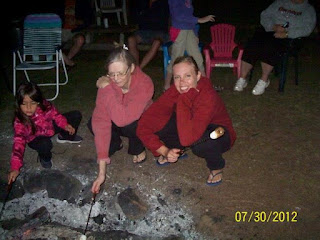
Making S'mores on my final night :) (again, pic stolen from Kris)
We used to spend a week during the summer at a cabin when my cousins and I were younger and it was really, really nice to do it again!  It was great to watch my cousins’ kids and relive some of my favorite childhood memories.  Also, though we agree on almost nothing (…), it’s a great feeling to just be with family, up at a cabin on a lake, removed from the grind of normal adult responsibilities.  I had to leave before the week was up for some technology training and curriculum writing days, but I truly enjoyed myself while I was there.

I do believe that is it, not so briefly.  It’s sort of depressing when your dad has way better stories to tell, but then again, I’m not half as crazy as they were at my age, so it’s to be expected.  I’ll try to write before another 8 months pass, but I’m not promising anything!


***********************************************************************************
You may have noticed that we've changed the color of the text.  In case you didn't, well, we did.  We got some feedback from readers that the way we had it was hard to read.  What do you think of this new color?  Let us know!

Monday, July 23, 2012

Chicago Days


By the end of 1982 my career as a railroader was coming to an end.  Jobs were becoming scarce and every year I would be called back to work later than the year before.  In order to have a year round job you needed to have between 10 and 15 years of seniority and it would be close to another decade before I would have reached that mark.

Just as important as the dearth of work, was the nature of the work itself.  In short, it was dangerous, dirty, and physically demanding and not the sort of thing you want to be doing, as you got older.  There were a few fifty-year-old trackman and they looked seventy.  These older guys were often ridiculed because they could no longer pull their weight.  It was not the type of future I saw for myself.  I had enjoyed myself greatly and really liked the people I worked with, but it was time to move on.

I had picked up a BA in History from the University of Wisconsin Milwaukee along the way, and began to consider law school.  My grades had been very good and I had little doubt I could get into one law school or another.  What I couldn’t stomach was leaving, what I considered the real world, to go back to academia for three years.  I had always done well in school but I could never wait to get out.

As I was thinking over my next step, a friend of my wife’s told her about a course of study that resulted in paralegal certification. I looked into it and found a program at Roosevelt University in Chicago that seemed custom made for me.  It was a 16-week program, 40 hours a week in class and another 20 to 25 hours outside class.  At the conclusion of the 16 weeks you received a paralegal certificate that would allow you to apply for legal positions in law firms, corporations and government offices.  So in April I moved to Chicago for four months.

On my second day of classes, a guy who had not been there on the first day, slipped into a seat next to me in the last row of the classroom.  During a short break, we began talking and discovered that we lived about eight blocks apart on the south side of Minneapolis.  Class ended early that day, and we found ourselves sitting in the Blackstone Hotel Peanut Bar around 3:00pm, getting to know each other.  As we sat there drinking pitchers of beer and eating peanuts, we found that we had mutual interests in baseball, history, politics, literature, film, and beer.  Thus were the seeds of a nearly 30 year ongoing friendship sown.

Right around 10:00pm, we stumbled out of the bar, and parted ways.  My friend was staying in the dorms right across the street from the hotel and he headed home.  I had rented a studio apartment, about six blocks from Wrigley Field, and decided to take the bus to the apartment because there was a bus stop about a half a block away.

As I waited for the bus, it occurred to me that it might have been a good idea to have visited the restroom before we left the bar.  I thought about going back, but was worried the bus would come while I was gone and I would have to wait for the next one.  I wasn’t too worried because the apartment was only about three miles away and, as my mother in law would tell me years later, I have a big tank.  I also thought the bus would zoom along like they did after 10:00pm on Tuesday nights in Minneapolis, and I would be home soon.

I waited a few more minutes and a bus packed with humanity pulled up and I got on.  I was surprised at the number of people on the bus at that time of night and had to stand the first several blocks.  As I was standing and the bus was stopping at every corner my condition began to concern me.  Every time the bus stopped three people would get off and four would get on.  I finally got a seat as the misery index ramped up.  We continued our block-by-block tour and anyone watching me probably thought I was a contortionist practicing on the bus.  I was able to refrain from out and out grabbing myself and hanging on for dear life, but just barely.  On and on we went as I unsuccessfully tried to concentrate on any thing other than my bladder.
 
Forty-five minutes later we arrived at my bus stop, which was three blocks from my place.  As the bus driver opened the door I flew out, already at full speed.  I covered those three blocks faster than if the hounds of hell were chasing me.  I think I would have won gold in the three-block apartment dash, if there had been a “Full Bladder Olympics.”  It was a painful reminder that mega cities never sleep.  There are always people around and public transportation doesn’t go quiet till the wee hours of the morning.

My “apartment” was a studio with a section of the one room serving as a kitchen.  The furnishing consisted of a kitchen table with three chairs.  It’s other inhabitants were a rather polite breed of cockroaches, which only occasionally came out to say hi.  At night I would sleep on an air mattress.  Early on the mattress developed a leak.  Every night I would blow up the mattress and would wake up at 3:00am lying on the floor.  There was a picture window overlooking an alley and the back of a three story gray brick apartment building.  The apartment building had wooden porches for each of the floors, which were accessed by a wooden staircase on one side of the building.

One early evening, I was daydreaming over my schoolbooks and looking out the picture window when a young man came out of the back door of one of the second story apartments across the alley.  I noticed how quickly he was moving and thought he must be late for something.  He took the steps two at a time and squatted down to unlock a bicycle that had been chained to a telephone pole in the alley.  Just as he was arriving at the bike, a woman burst out of the same apartment wearing only a towel.  The woman caught up with the man as he was trying to work the combination on his bike lock and assumed a prizefighter’s stance.  She was bobbing and weaving, up on the balls of her feet and began throwing left jabs and right crosses at the man’s head.  She was connecting often enough to cause the man to have to start over with his lock combination.  He was trying to ward off her punches with one hand while working the combination with the other.  He was clearly taking some pretty good shots, when he reached up and tore the towel off the women and threw it across the alley.  This maneuver had absolutely no effect on the women as she continued to pummel the guy.  He eventually got the lock off and threw his leg over the bike and started peddling down the alley.  The women ran along beside him, throwing punches at his head until he picked up enough speed to out distance her.  She turned around and calmly walked back up the alley, picked up her towel and went back in her apartment.

I never knew if this was a lover’s spat or more likely, a commercial transaction gone bad.  It certainly spiced up a night of studying.  As I was recalling this incident, I came up with an idea for a reality TV show that combines the twin American obsessions, sex and violence.  I would call it, “Birthday Suit Boxing.”  It would have the advantage of being every bit as degrading, morally bankrupt and stupid as the current reality shows that litter the network and cable stations.

Imagine the possibilities.  Feuding neighbors could settle their differences by taking off their clothes and climbing into the ring.  You might think people would be shy about boxing au natural but, as we have seen time and time again, the lure of getting oneself on television overcomes all common sense, decorum and self esteem.

The show could start out with a couple of bouts featuring “average Joes and Janes” who have a score to settle.  Their back-stories would no doubt be revealing and intriguing TV.  Then the show could be topped off with a celebrity bout.  These celebrities could come from the world of film, TV, sports or politics.  Imagine a three rounder featuring Janet Reno vs. Karl Rove.  Who wouldn’t take time out of their busy schedule to watch that fight?  Fan favorites could make arena tours, similar to American Idol tours.  This is can’t miss TV.  So, if you are in entertainment or know some one who is, have them contact me through the comments section of this blog (it works now) and we will get this juggernaut rolling.

The neighborhood I moved into was an interesting mishmash.  The two or three blocks around my apartment were largely blue collar, lower middle class dwellings.  A couple of blocks over toward the lake were very expensive condos and apartments with lake views.  Just about four blocks south of where I lived was an area that was described to me as, “the rough-trade gay” section.  I wasn’t too sure what that meant but the people there were something to see.  There were the “usual” leather type guys; along with guys sporting pink or neon green Mohawks.  There were people with shaved heads and leopard spots tattooed on their skulls and a whole lot of muscle freaks.  Body piercing was common.  None of this would be all that outrageous today, but this was 1983 and these guys were way out on the edge.

When I got bored or lonely, I would walk about three blocks to a working class bar and sit and have a few beers while watching the Cubs on TV.  One night a young Mormon sat down next to me and in the course of really getting drunk, told me about his problems with his father and his religion.  I don’t remember what advice I gave him, if any, but I’m sure that anything I told him was laced with wisdom and Old Style beer.

Another late afternoon, I was watching the Cubs lose another game, when a young man sat down next to me and struck up a conversation.  I didn’t think much of it as this often happened and I enjoyed shooting the breeze with just about anyone.  As the game went on, I noticed my new friend would sometimes punctuate a point he was making by laying his hand on my forearm.  Once or twice, he turned toward me on his bar stool, and touched my knee.  By the time he was telling me that he bet I was at the very top of my class, it finally dawned on me, he was trying to pick me up.  I waited for an appropriate juncture in the conversation, not wanting to appear rude or give him the impression I was some how horrified by his efforts, and told him I was just there to watch the baseball game and wasn’t interested in anything else.  Unfortunately, he wasn’t going to be put off that easily, and he got more aggressive.  When he turned to say something to another patron, I finished my beer and left.  As I rounded the block on my way home I saw that he was following me.  I quickened my pace and made it to my apartment before he could catch up.  I watched from the second floor lobby of my building as he walked back and forth in front of the building.  Eventually he gave up and left.

The experience gave me a new empathy for women who have to put up with this sort of bullshit all the time.  I have to admit, this guy creeped me out, but at least I wasn’t physically frightened.  Women often have to deal with the fear of being beaten and/or raped along with the nuisance factor.  It opened my eyes to just how unsettling this type of behavior can be for the person on the receiving end of it.

That summer in Chicago turned out to be a valuable one for me.  I learned once again that I was not cut out for life in the mega cities and much-preferred making my home in cities with populations more in line with Minneapolis. Chicago was a great place to spend time.  I really enjoyed its blues bars, public art, ethnic restaurants and great museums.  I just didn’t like the pressure of so many people being around all of the time.  Some times I need a break from my species and the mega cities don’t often afford you those times.

I did complete my program with honors and received my paralegal certificate.  Armed with that piece of paper, I was able to return to Minneapolis and start what would become a 25-year career in a Fortune 300 financial services company.

Just as important, I made a good friend, who also carved out a successful 25-year career in downtown Minneapolis.  Now we are retired and going to Twins games, drinking beer, and taking hikes.  As you get older, you realize the importance of having good friends.  They are a big part of what makes life worthwhile.  So nurture your friendships.  You will need them up until the day you meet your maker.

And last, but certainly not least, my wife proved to me that she did in fact love me when she visited Chicago for a long weekend.  On Saturday morning, I asked her what she wanted to do on her first full day in Chicago.  She replied that she heard there was a Cub’s double-header over at Wrigley Field and would I like to take her there?  True love, beyond a doubt.

Next:  The Teacher surfaces.